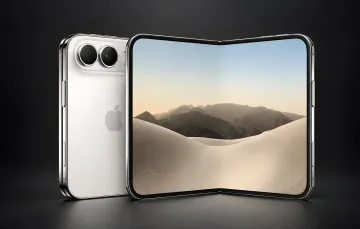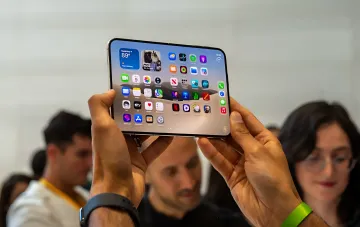
Apple has gone against the main trend in foldable smartphones: instead of the narrow, tall body offered by competitors, the company unveiled the iPhone Duo with unusual wide-format proportions. Behind this design bet stand two key figures — chief designer Molly Anderson and Vice President of Interface Design Steve Lemay — who publicly explained why Cupertino consciously abandoned the familiar form factor and exactly how the device should feel in the user's hands.
Against the Trend: Wide Format Instead of Narrow
The main difference between the iPhone Duo and other foldable smartphones is the geometry of the screen and body. Where most models yield a stretched 'vertical' panel when unfolded, Apple bet on a wide format. According to Molly Anderson, in its folded state the device remains compact and convenient to carry, while unfolded it offers noticeably more working space. It is precisely this pair of properties — compactness in the pocket and room on the desk — that became the starting point for choosing the proportions.
'Paper Notebook': The Design Philosophy
The central idea voiced by Molly Anderson is to make the gadget feel like a traditional paper notebook. The proportions of the iPhone Duo are based on the international A-series paper format system, in which the aspect ratio remains unchanged even when the sheet is folded in half. This approach preserves a unified visual perception of the content in both the folded and unfolded states, which, by the designers' intent, makes the transition between modes natural and not 'jumpy.'
Titanium Frame and Adaptive Hinge
Among the structural features of the iPhone Duo are a curved titanium frame and a special hinge that changes its resistance during movement. Thanks to this, the mechanism unfolds smoothly and reliably locks the device in a fully flat position. The combination of a titanium body and an adaptive hinge is designed to solve two tasks at once: ensure the durability of the foldable structure and give the user a predictable, 'snapping' opening without any play.
Steve Lemay on Seamlessness and the Software Foundation
Steve Lemay, Vice President of Interface Design, emphasized that Cupertino sought to avoid the feeling that, at the moment of opening, the user is switching to a completely different gadget. In his words, the iPhone Duo's operating system is built on the best work done on the iPad, Macintosh, and previous iPhone models. This approach is meant to make the transition between the regular and foldable modes seamless: the interface, animations, and use cases are structured as a single whole, not as two separate products.
Bet on Third-Party Developers
Among the device's key features, experts highlight the software side and the screen, as well as the combination of thoughtful hardware with seamless animations. Apple expects that precisely the unique form factor, combined with the familiar ecosystem, will inspire third-party developers to create new use scenarios for the iPhone Duo. Thus, the company is betting not only on hardware novelty but also on the wide format becoming a reason for developers to rethink applications for the foldable scenario.