
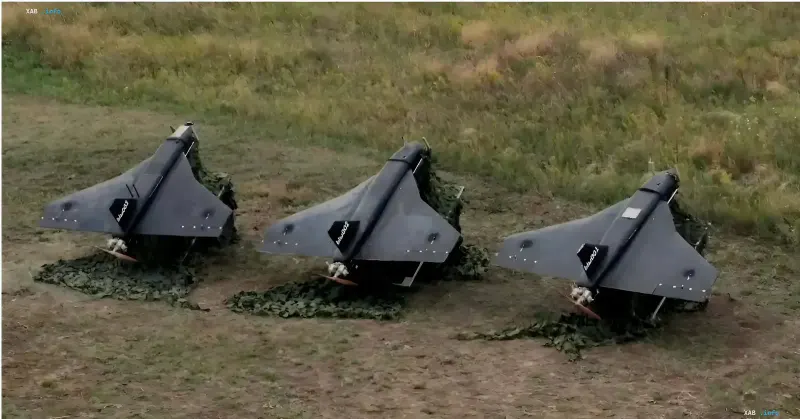
According to the eRadar monitoring channel, cited by Kyiv Post, on August 18, 2026, a Russian unmanned aerial vehicle was launched from the territory of Crimea, identified as a modified Shahed equipped with a jet engine. The aircraft flew over Mykolaiv, Vinnytsia, and Khmelnytskyi oblasts, then passed near Kremenets in Ternopil Oblast and reached the area of the city of Dubno in Rivne Oblast. The total route distance, including maneuvers, is estimated at 850–920 km, and the straight-line penetration depth from the launch point exceeds 720 km — a figure previously unrecorded for aircraft of this class.
Calculated Trajectory and the Search for Air Defense Vulnerabilities
eRadar analysts emphasize that the trajectory was planned in advance to bypass key areas where Ukraine's surface-to-air missile systems are deployed. The flight over the southern, central, and western parts of the country is regarded as reconnaissance by fire: according to this version, Moscow is studying the air defense system and seeking new penetration corridors. As noted in the monitoring channel, it was precisely the jet thrust, which allowed speeds of 400–600 km/h, that significantly complicated the interception of the aircraft by small arms and heavy machine guns, making traditional mobile interception groups "completely unsuitable" for such a task.
Range Doubled: What It Means for the Western Regions
Previously, jet-powered UAVs of this type had a maximum range of about 500 km, which limited their use to strikes on Kyiv, Kharkiv, Odesa, Sumy, Poltava, Dnipro, and Chernihiv. The August 18 route was almost twice as long, which, according to eRadar's assessment, indicates a possible design upgrade and a significant increase in flight range. The channel states outright that the expanded operational range puts "almost the entire territory of Ukraine, right down to the most remote areas on the western border" under potential threat.
Context: Expansion of the Launch Site Network
A separate report by the Institute for the Study of War (ISW) dated August 17 records Russia's expansion of the network of UAV launch sites, with western Ukraine being considered a potential future target. Anton Zemyany, a senior analyst at the Ukraine Center for Security and Cooperation, notes that Moscow is increasingly shifting to high-speed aircraft against the backdrop of declining effectiveness of traditional propeller-driven Shaheds in large-scale attacks. The interception of the described UAV, according to Ukrainian monitoring systems, was carried out by the Ukrainian Air Force approximately 30 minutes after it had passed several sections of the route.
Contradictory Data
The available wording contains a number of inconsistencies. First, in the Kyiv Post/eRadar text the aircraft is described as having "reached" Dubno, while at the same time its interception by the Air Force is reported — it is not specified whether it was shot down before or after passing this point. Second, the eRadar quote on the inability to intercept contains a strange formulation about "mobile fire brigades," which is likely a translation artifact and does not correspond to standard air defense terminology. Third, the increase in range to 850–920 km is interpreted by eRadar as evidence of a design modernization, however no independent technical confirmation (interception video, debris, engine characteristics) has been provided in open sources at the time of publication. The ISW and Zemyany data are of an analytical nature and do not directly confirm the specific incident of August 18.