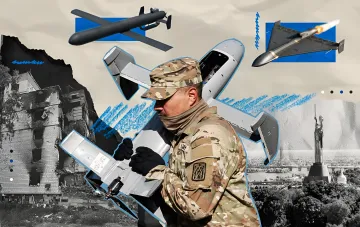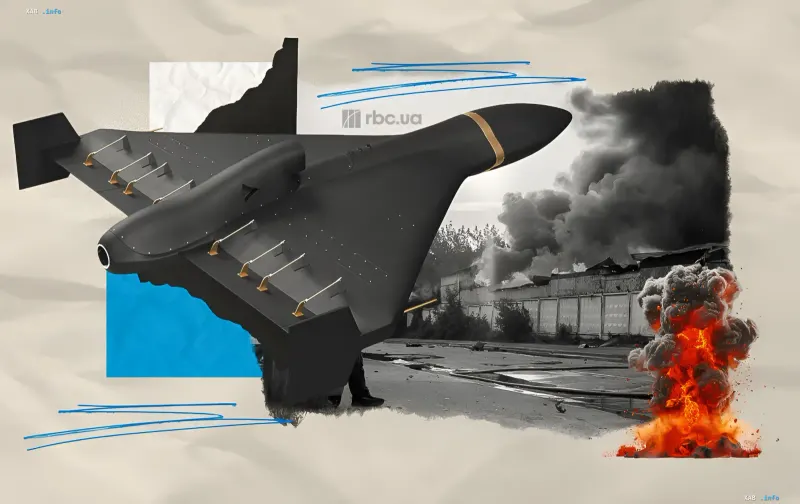
The effective short-range air defense system built by the Ukrainian Defense Forces has significantly reduced the combat value of classic 'Geran-2' drones with internal combustion engines: according to expert estimates, their effectiveness has dropped to 10–20%. This result became the stimulus for the enemy to scale up launches of jet-powered unmanned aerial vehicles. This was explained in an exclusive column for RBC-Ukraine by Kirill Lyukov, head of the drone technologies department at the Serhiy Prytula Foundation, who explained why jet drones have become a serious challenge for Ukraine's air defense and how attacks may change in the future.
Speed as the Key Change
According to the expert, Russia has begun converting launch sites for the deployment of 'Geran-3' and 'Geran-4' drones, 'Geran-5' and 'Banderolei' drone-missiles, as well as creating new sites directly near Ukraine's state border. The key change for the Defense Forces has been speed: if previous versions of the 'Shaheds' were relatively slow targets, the new jet drones reach speeds of 300 to 600 km/h. The first jet modification to be detected in Ukraine's airspace was the 'Geran-3', based on the 'Geran-2' airframe with an 80 kgf turbojet engine, capable of accelerating to 370 km/h. It subsequently became a transitional platform for the mass appearance of the 'Geran-4', with an enlarged airframe and a 160 kgf engine, operating at speeds of 400–600 km/h.
Foreign Components in Russian Assembly
The increase in speed has allowed the enemy to expand the use of jet 'Shaheds' while Ukraine adapts its countermeasures. Russia is taking advantage of the fact that the effectiveness of these drones remains fairly high: the enemy is increasing the number of units and launches while simultaneously trying to localize their production as much as possible. At the same time, some components remain foreign — in particular, this refers to turbojet engines produced by the Chinese company Telefly.
Why Jet Drones Are Harder to Shoot Down
The main problem is the speed of the aerial target, which significantly reduces reaction time and creates additional difficulties for engagement. 'Classic' interceptor drones lose effectiveness due to limitations in peak speed and time aloft, while surface-to-air missile systems remain a scarce resource primarily due to a shortage and the cost of interceptor missiles. Nevertheless, jet UAVs are already being hit: there are successful cases of using interceptor drones, although multirotor interceptors engage such targets more as an exception. One of the working methods is interception during turns and maneuvers, when the 'Geran-4' loses speed.
Effective Means and the Search for Interceptors
One of the effective means remains man-portable surface-to-air missile systems (MANPADS), whose effectiveness depends on the distance and altitude of the target, as well as the training and combat experience of the crews; they have to be modernized and fitted with thermal imaging sights and auxiliary systems. Mobile fire groups with machine-gun armament are still limited by engagement range and reaction speed against a faster target, while for point defense a working option remains automated turrets with machine-gun armament and anti-aircraft guns with high-explosive shells, whose engagement range can reach 2.5 km. In parallel, the search for jet interceptors continues: there is no off-the-shelf solution yet due to the difficulty of scaling jet engines and the cost of the finished product, so one of the directions becomes the automation of the entire process — from launch and reaching the target area to automatic capture and detonation.
A Full Air Defense Overhaul Is Not Needed
In the longer term, the priority remains relatively inexpensive short-range interceptor missiles capable of engaging a wide spectrum of aerial targets — from the 'Geran-4' to the 'Banderolei' and even cruise missiles. At the same time, the appearance of jet drones does not mean that Ukraine needs to completely rebuild its air defense system: it will continue to remain a complex of forces and means within the framework of short-range air defense and combat deployments along the front line. The detection system is already working quite effectively against the new threats, and the main question now is the means of engagement and the reorganization of combat deployments and crews with various types of armament against the enemy's potential targets. Expanding the radar field and other detection sensors remains a constant task, since even the best countermeasure cannot cover the sky without precise and timely target detection.