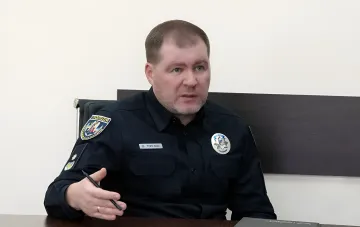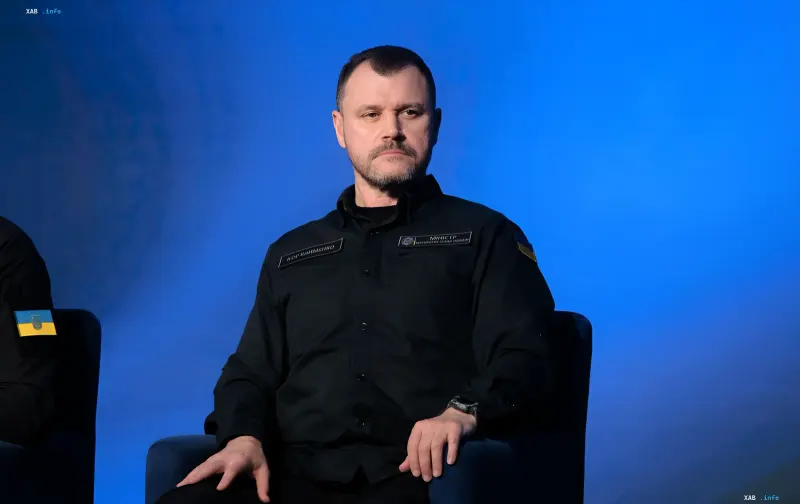
Secretary of the National Security and Defense Council of Ukraine Ihor Klymenko has publicly commented for the first time on his surname appearing in the recordings released by the National Anti-Corruption Bureau (NABU) as part of the case concerning the 'Khimprom' drug syndicate, known in the media space as the 'Carthage' case. Speaking at a meeting with journalists, the official reacted emotionally to his name featuring in the investigation materials and detailed the pressure mechanisms that, according to him, the criminal group applied against civil servants.
'Information bombs' and the threat of a political crisis
According to Klymenko, the recordings feature one of the group's leaders nicknamed 'Mexican' — Yegor Burkin, whom NABU Detectives Head Oleksandr Abakumov previously named as the leader of the Russian 'Khimprom' drug syndicate — threatening to trigger a political crisis in the country, orchestrate the dismissal of the Ministry of Internal Affairs leadership, and launch a large-scale information campaign with fake materials via a number of Telegram channels and websites. 'In other words, they used such information bombs to blow things up, to undermine officials' reputations in this informational noise. It was an element of pressure,' the NSDC Secretary stated.
Shadow budgets and the search for leverage
Klymenko recalled that the criminal group possessed colossal shadow budgets and purposefully sought ways to influence the then-Minister of Internal Affairs so that he would not initiate restrictions capable of undermining their illegal business. According to NABU data, it was Burkin ('Mexican') who tried to block the ban on synthetic cannabinoids in Ukraine, using both direct contacts with officials and threats of a public scandal for this purpose.
Legislative gap and store network
The NSDC Secretary noted that the group exploited gaps in Ukrainian legislation regarding synthetic cannabinoids and distributed narcotic substances through a network of specialized stores. Closing this legal loophole required developing a resolution in which, according to Klymenko, 'chemical formulas had to be written out.' Work on the document took two and a half months, and the initiative was agreed upon with the Ministry of Health and the Head of the National Police. 'It was important to truly ban all derivatives belonging to this chemical element,' he emphasized.
Liquidation of the network and further steps
Klymenko reported that following prolonged operational work, investigations, and the adoption of relevant government decisions, law enforcement agencies completely liquidated the store network back in April. According to him, not a single such point is functioning today, but work to identify and bring all involved individuals to criminal liability continues. Thus, the 'Carthage' case remains open, and investigative bodies intend to carry out procedural work until all links of the criminal structure are fully exposed.