The team at the American laboratory Pioneer Labs has unveiled the Mars Seed project — an autonomous bio-factory designed to produce structural bioplastic directly on Mars. The key constraint that guided the architecture was mass: the entire installation must fit within a single cargo flight of about 20 tons. Once deployed, the system is designed to operate without raw material supplies from Earth, utilizing the Martian atmosphere, subsurface water ice, and regolith. According to the authors' estimates, such a solution allows the costs of delivery and deployment to be recouped in approximately two orbital periods of Mars and Earth relative to each other, after which production can continue without new supplies.
Bioreactors and the Strain That "Builds" Plastic
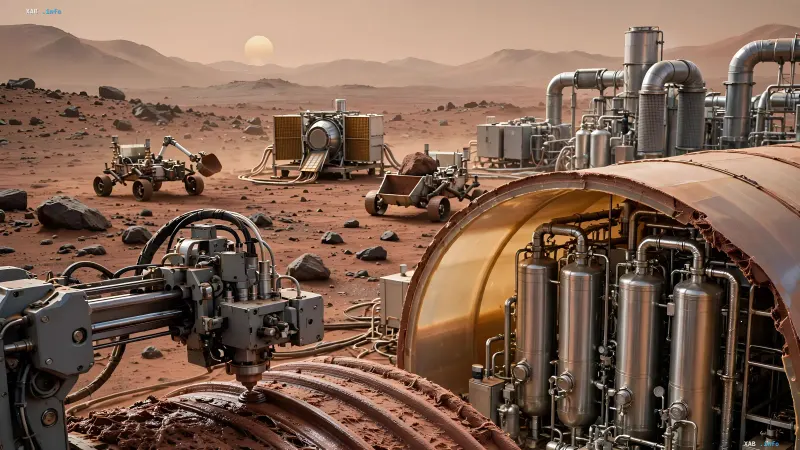
The core of production will consist of four 1,000-liter bioreactors used to grow a specially adapted strain of the bacterium Cupriavidus necator — sPL.001. This microorganism is capable of accumulating polyhydroxybutyrate (PHB), a type of bioplastic, inside its cells. Unlike industrial production on Earth, where bacteria require sugars and nutrients from agricultural raw materials, Mars Seed is designed to obtain all necessary components directly on Mars, eliminating dependence on Earth logistics.
From Carbon Dioxide to Acetic Acid
To feed the bacteria, atmospheric carbon dioxide will first be split by electrolysis into carbon monoxide and oxygen. Then, the carbon monoxide along with water will undergo a second stage of electrochemical processing, resulting in acetic acid — a source of carbon and energy for the microorganisms. Oxygen will be additionally utilized within the bioreactors themselves. According to the authors' calculations, the facility processes 48.4 kg of CO₂ and 19.8 kg of water daily, yielding 33 kg of acetic acid and 35.2 kg of oxygen.
Regolith as Raw Material and Water from Ice
Mineral substances for the bacteria are extracted from Martian soil: regolith is mixed with water to dissolve nitrogen, phosphorus, sulfur compounds, and other trace elements. Preparing the nutrient medium requires about 800 kg of soil per day, with another 3,200 kg used as construction material and protective backfill — meaning transport robots will need to deliver about 4 tons of regolith to the factory daily. Water supply will be provided by a borehole utilizing the heat of a nuclear reactor to melt subsurface ice, with a projected purification and water recycling efficiency of 80–90%.
From Biomass to Airtight Module
During a 29-hour fermentation cycle, the bacteria accumulate PHB and are then separated from the liquid via centrifugation. The four reactors yield about 14 kg of bacterial biomass per day, containing roughly 10 kg of pure biopolymer. The raw material is split into two streams: the first half of the biomass is mixed with regolith and sent to a construction 3D printer to form the outer shell of the habitat modules, while pure PHB is extracted from the second half using liquid and supercritical CO₂ to manufacture the airtight inner lining. Each habitat module is a semi-circular structure 5 m wide and 15 m long (75 m², designed for two people according to NASA standards); the outer composite layer is covered with a 2-meter layer of soil for protection against radiation, temperature fluctuations, and micrometeorites, while the inner PHB layer maintains an atmosphere at a pressure of about 57 kPa. Each module consumes approximately 1,300 kg of pure PHB.
Timelines, Energy, and What Remains to Be Tested
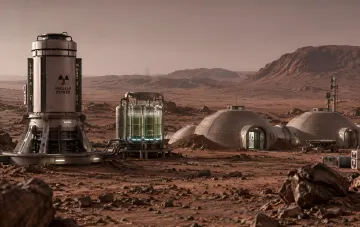
According to Pioneer Labs' calculations, the 20-ton equipment will provide construction for 870 m² of living space in approximately 1,500 Martian sols (about 50 Earth months), of which the first 90 will be spent on deployment and production startup. Electric power will be supplied by a 40 kW nuclear reactor, and its waste heat will be used to extract water from ice. Individual elements of the technology have Earth and space analogs, and the ability of the sPL.001 strain to produce bioplastic on a Martian soil simulant medium has already been tested in laboratory conditions. However, the entire chain — from raw material extraction to the manufacture of an airtight habitat module — has yet to be assembled and tested as a single system.