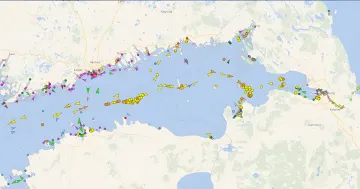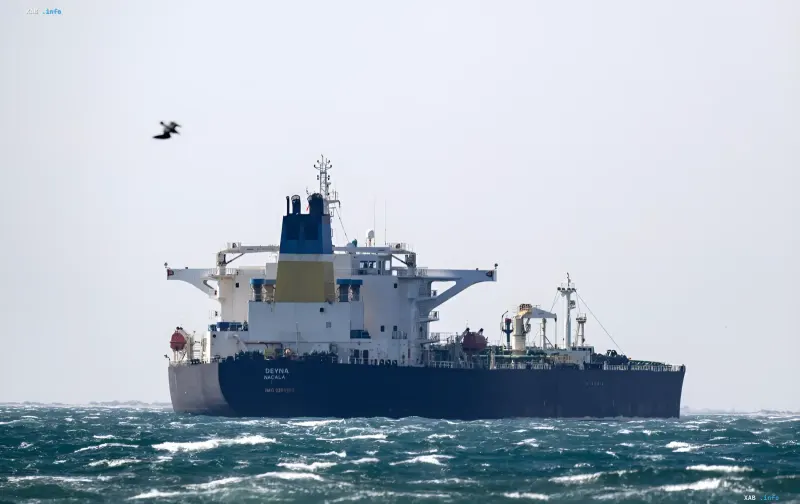
The Armed Forces' Unmanned Systems Forces (USF) have drawn up the results of ten weeks of Operation "MoloChka," aimed at Russia's shadow fleet in the Black Sea and the Sea of Azov. This was announced, according to RBC-Ukraine, by USF Commander Robert "Myar" Broydi in his Telegram channel. In his words, over the course of the campaign Ukrainian military "hunted" 285 vessels of the shadow fleet, including oil tankers carrying Russian oil. Broydi emphasized that ships exporting oil through the Bosphorus generate revenue for Moscow that, in his assessment, can be used to finance the war.
Ten weeks of the hunt: how Operation "MoloChka" is structured
Operation "MoloChka" has been underway for ten weeks and is focused on the Sea of Azov and the Black Sea, where, according to USF command, key routes have been "completely" blocked — in particular, in the area of Azov and Kerch. The target set of the campaign is the shadow fleet's vessels, above all oil tankers involved in exporting Russian oil. The USF Commander stressed that it is precisely these shipments that generate financial flows for the Russian Federation which, in his words, go toward conducting hostilities. Thus, the operation is positioned not only as a tactical but also as an economic measure of pressure on "oil" export logistics.
"Marine cyberpunk": an unmanned helicopter escorts a tanker
Along with the results, Broydi published a video clip he called "marine cyberpunk." In the footage, an unmanned helicopter escorts a sanctioned shadow-fleet oil tanker, demonstrating, as the author intended, the capabilities of remote surveillance and pressure on vessels. The video is used as an illustration of the new quality of USF maritime operations, in which unmanned platforms are employed to escort, identify and, where necessary, strike targets in the waters of the Black Sea and the Sea of Azov.
Context: the parallel "Crimean Switch Off" campaign
Operation "MoloChka" is being conducted in parallel with another USF campaign — "Crimean Switch Off." According to previously published data, within the framework of this operation, from 6 July to 9 September, 374 energy nodes in Crimea and other occupied territories were struck. Among the targets were thermal power plants, electrical substations, railway traction substations and gas distribution stations. The combination of the two campaigns — maritime and energy — points to the systematic nature of USF actions against the infrastructure and logistics that, in Kyiv's assessment, sustain the military and economic resilience of the Russian Federation.
Contradictory data
In the wording used by various outlets relaying Broydi's statement, there is a notable inconsistency in the verb describing the fate of the 285 vessels. In one RBC-Ukraine message, the forces are said to have "hunted" 285 vessels; in a 24tv.ua headline, the USF are said to have "identified" 285 shadow-fleet vessels; meanwhile, in an UNN.ua publication and in the general description of the campaign, the phrasing "struck 285 vessels" appears. In other words, some sources interpret 285 as the number of identified/pursued targets, while others — as the number actually struck. The USF Commander himself, in the available quotes, gives no clear distinction between "identified," "pursued" and "struck." Until independent verification emerges, it is more accurate to speak of 285 vessels featured in the USF report on the results of ten weeks, without a guaranteed assertion that all of them were destroyed.
It is also worth noting the weekly dynamics: according to Interfax-Ukraine, over the period from 1 to 11 September alone, the USF reported neutralizing 16 units of the Russian shadow fleet. This figure is consistent with the overall scale of the campaign and shows that the intensity of strikes in recent weeks remains high. Taken together, the USF command's statements paint a picture of a prolonged, multi-target maritime operation, however the key quantitative indicators so far rest on one-sided military reports and require additional verification.