Paleontologists have announced the discovery of a new species of prehistoric reptile that lived on our planet about 125 million years ago. The find was made in the modern Liaoning province of China, an area renowned for its rich Early Cretaceous fossil deposits. The new species has been named Kairasaurus changliensis and has immediately captured the attention of the global scientific community with its unique anatomical features.
Anatomy and Features of the 'Feathered Bear'
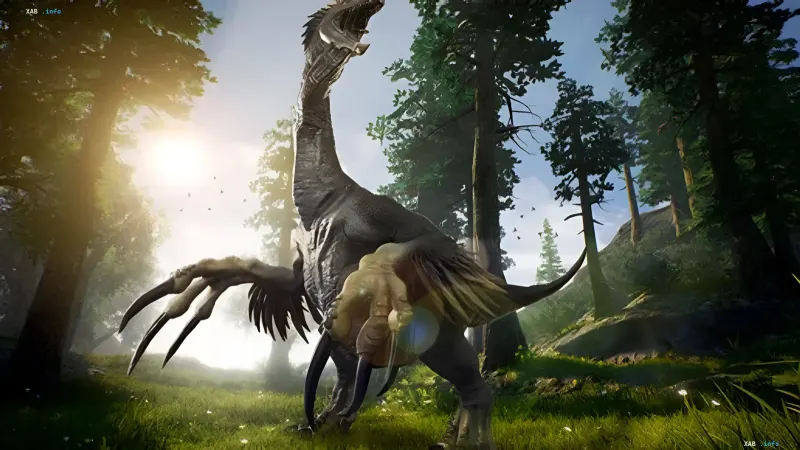
Researchers classify the discovered animal as a therizinosaur. Due to its massive build and specific covering, this bipedal reptile earned an informal comparison to a "feathered bear" among researchers. The reptile's main trademark became the incredibly long and powerful curved claws on its forelimbs, the exact purpose of which is still actively debated in scientific circles. The nearly complete skeleton that formed the basis of the fundamental study belonged to an individual that had not yet reached full biological maturity.
Unique Parameters and Diet
Despite the young age of the discovered specimen, its physical parameters are impressive: its body length exceeded 3.6 meters, and its estimated weight was about 275 kilograms. Another striking anatomical detail of Kairasaurus was its unusually small and densely packed teeth. Jaw analysis revealed the presence of more than 32 tooth sockets on each side of the upper jaw and at least 45 on the lower, totaling over 77 teeth. Although the distant ancestors of therizinosaurs were fearsome carnivorous theropods, this species completely transitioned to a plant-based diet during evolution, using its long necks and claws to forage for foliage.
Significance of the Discovery for Science
According to leading paleontologists, the discovery of Kairasaurus changliensis makes a massive contribution to understanding the ecosystems of the Jehol biota. The find allows scientists to much more accurately reconstruct the evolutionary pathways of therizinosaurs, their ecological adaptations, and the mechanisms of body size variation during the Early Cretaceous epoch. Further study of the remains will help shed light on many mysteries of ancient Asian fauna.