
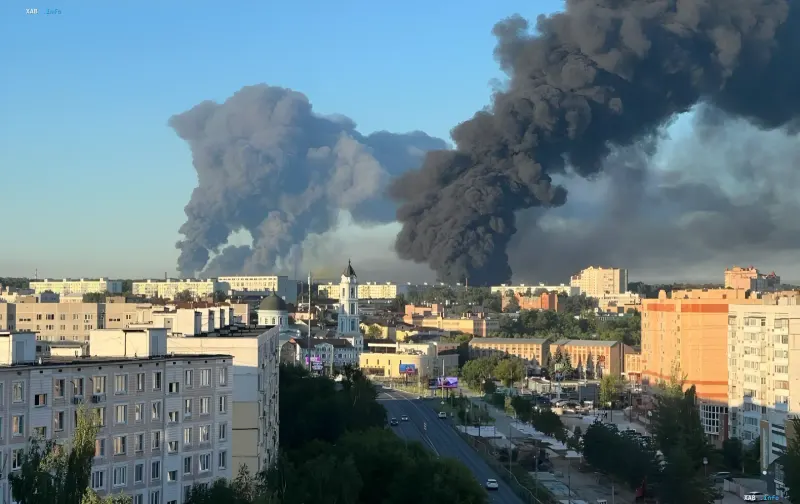
On August 19, 2026, the Russian market for automotive lubricants faced an unprecedented crisis. The cause was not only general economic instability but also the direct consequences of strikes by Ukrainian unmanned aerial vehicles (UAVs) on strategically important oil refining industry facilities. Colossal columns of black smoke rising over industrial zones became a symbol of the destruction of logistics chains and production, which immediately reflected on store shelves and in the pockets of car owners.
The Domino Effect: From Refinery Explosions to Empty Shelves
The situation in the lubricant market is developing according to the "domino effect" scenario. Strikes on oil refineries (ORs) led to their forced shutdown and unscheduled repairs. This not only reduced fuel output but also paralyzed the production of base oils, which are the foundation for lubricants. Experts note that the market faced a double blow: physical destruction of capacity and a shortage of imported additives necessary for creating quality oils.
Vladimir Andreev, head of the service division of the automotive marketplace Fresh, describes the situation as rapidly deteriorating. According to him, over the last two months, oil prices have risen by 1.5–2 times. Delivery times, which previously took two days, have stretched to two weeks. "There are no individual items of popular oils at all — we are buying from intermediaries what manufacturers managed to ship earlier," the expert states, noting that services are forced to work in survival mode, purchasing leftovers on the secondary market.
Price Shock and Assortment Shortage
The price increase has become a systemic phenomenon. Tatyana Ovchinnikova, director of the Fit Service auto service network, reports that since the beginning of 2026, automotive oils have already risen by 15–20%. At the same time, forecasts for the near future look pessimistic: prices for individual products could rise by another 40%. The shortage affects not only motor oils but also other types of auto chemicals, in particular, coolants, the production of which also suffers from a lack of raw materials.
Paradoxically, the crisis is exacerbated by the quality of fuel itself. Due to the shortage of quality gasoline in Russia, fuel of a lower environmental class began to be used. This requires car owners to change motor oil more frequently, which, in turn, stimulates demand against the backdrop of its physical absence. Thus, a vicious circle is formed: poor fuel wears out engines faster, requiring more oil, which is not available for sale.
Contradictory Data
There are discrepancies in versions regarding the assessment of the scale of destruction and the causes of the shortage. According to data from independent observers and reports from Western media, over the last few months, drone strikes have disabled up to 40% of the country's oil refining capacity, which led to about a third of Russians facing a fuel shortage. However, Russian official sources often downplay the scale of the damage, calling incidents "local fires" and asserting that refining is operating in normal mode. Despite this, the actual rise in prices and empty shelves in the regions confirm the version of a systemic crisis caused by physical damage to infrastructure.
Regional Control and Social Tension
The situation with fuel and oil shortages has led to the intervention of regional authorities. In at least 10 regions, local administrations have strengthened control over the sale of gasoline at gas stations, introducing restrictions on the volume of fuel dispensed per car. This indicates that the problem has gone beyond purely market mechanisms and has acquired a social character. In conditions where even the basic needs of car owners cannot be met, social tension and distrust in the state's ability to ensure stability in critically important sectors of the economy are growing.