Modern astrobiological research shows that billions of years of a planet's existence do not guarantee the development of complex life. Exoplanets located in habitable zones may be inhabited exclusively by primitive microorganisms. A recent large-scale study by scientists published in the International Journal of Astrobiology demonstrates that the key factor for the evolution of living organisms is not so much the age of the celestial body as the amount of energy it can accumulate through photosynthesis.
Modeling the Potential of 29 Exoplanets
The researchers focused on 29 closest exoplanets where liquid water could theoretically exist on the surface. Mathematical modeling yielded striking results: only on two of these worlds — GJ 1061c and K2-3d — did biological systems have a real chance to evolve into complex forms potentially surpassing Earth's metrics. For the absolute majority of other celestial bodies, critical constraints were a shortage of sunlight, extreme temperatures, and a lack of precipitation.
The Role of Photosynthesis and the Carbon Cycle
Scientists explain the fundamental mechanism: vegetation converts starlight into accessible chemical energy, forming a reliable foundation for the emergence of complex animal organisms. To assess evolutionary potential, the researchers compared the amounts of bound carbon on Earth with the calculated capabilities of other planets. Over 3.2 billion years before the appearance of vascular plants, about 2.4×10²⁵ grams of carbon were bound on our planet, and the further development of flora added another 7×10²⁵ grams, which allowed mammals and humans to appear. By comparison, the well-known exoplanet TRAPPIST-1e has accumulated only 21 percent of Earth's pre-plant level throughout its history.
Problems of Red Dwarfs and Water Scarcity
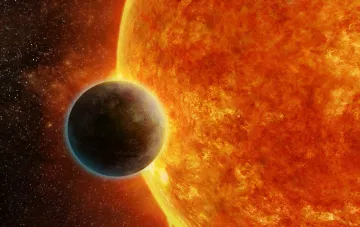
Most of the studied planets orbit dim red dwarfs and always face their star with only one side due to tidal locking. Because of this, the annual light influx on them is extremely small, and photosynthesis is supported on only half of the surface. Even assuming that such worlds are much older than Earth, life there is stuck at the bacterial stage. An additional constraining factor is the catastrophic lack of rainfall. As researchers colorfully put it, if intelligent civilizations ever form on such exoplanets, their environment will resemble the desert Arrakis from Dune rather than moisture-rich tropics.