One of the main problems in modern astrobiology is that a planet can be suitable for the emergence of life while remaining uninhabited. When observing exoplanets at distances of tens, hundreds, and thousands of light-years, astronomers are forced to rely on indirect signs — primarily the composition of the atmosphere. However, many chemical compounds traditionally considered markers of biological activity can also form as a result of purely geological processes. This is precisely the problem addressed by a new computer model developed by researchers in the US, notably from the University of Washington.
Digital Twin of a Planet Without Biology
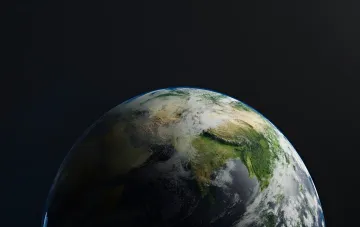
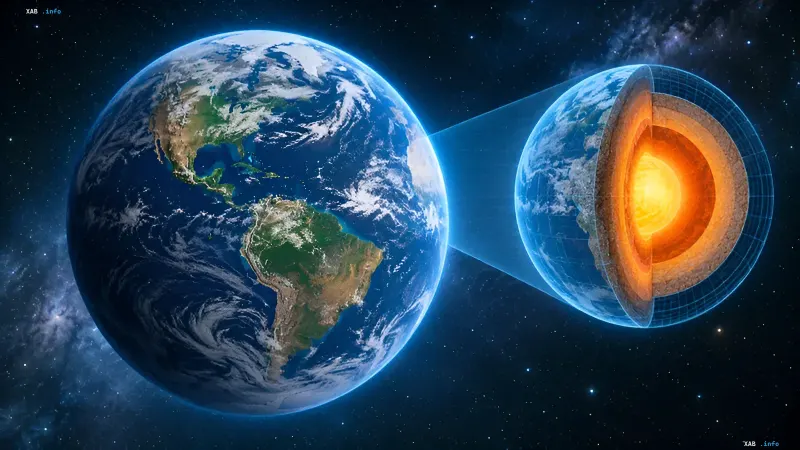
Scientists have created a computer model of the Earth that completely excludes the influence of living organisms. The model is a one-dimensional system linking the core, mantle, crust, and climate. It is built on the VPLanet software package and supplemented with calculations of the carbon cycle, water transport between the mantle and surface, evaporation, precipitation, and atmospheric dynamics. Specifically, it accounts for volcanic carbon dioxide degassing, chemical weathering of rocks, ocean absorption of CO₂, and its return to the atmosphere. The calculation covers the period from 50 million years after the Earth's formation up to 5 billion years of age — roughly 500 million years into the future from the present moment. Meanwhile, the initial stage of the planet's existence with a global magma ocean was not considered in the model.
Verification Against 19 Parameters of Pre-Industrial Earth
For validation, the developers compared the calculation results with 19 characteristics of pre-industrial Earth, including surface and mantle temperatures, interior heat flow, Earth's core parameters, magnetic field, surface albedo, and atmospheric composition. The obtained values fell within measurement error margins, confirming the model's adequacy. It is worth noting that to date, astronomers have discovered over 6,000 exoplanets and are actively studying their atmospheric composition in search of potential biological markers, making an accurate calibration tool critically important.
Lifeless Earth Does Not Give Itself Away with Oxygen
The main result of the work is that the simulated lifeless Earth maintains conditions allowing for liquid water, yet its atmosphere lacks significant amounts of oxygen, ozone, and methane. This results in the absence of characteristic spectral absorption bands for these gases — specifically, the oxygen band around 0.76 µm and the ozone band around 0.25 µm. In other words, by all visible signs, such a planet could be a cradle of life, but no biological traces are found in its atmosphere. The researchers also calculated possible spectra of sunlight reflected from the lifeless Earth in the 0.2–2.0 µm wavelength range.
Calibration for the Habitable Worlds Observatory
The obtained spectral data will be used in designing the future Habitable Worlds Observatory (HWO) space telescope, intended to search for habitable worlds. In this context, Earth acts as a calibration tool: knowing what the spectrum of a planet without biology looks like, astronomers will be able to more accurately interpret signals from exoplanets. The authors intend to use the development as a reference for bio-signature searches: if an exoplanet's observed spectrum cannot be explained by the combination of known non-biological processes recorded in the lifeless Earth model, this will provide grounds for a closer examination of that world for the presence of life.
Why This Matters for Astrobiology
Before this model appeared, existing approaches did not combine all key physical and geochemical processes determining a planet's atmospheric composition into a single system. The new development closes this gap, allowing researchers to quantitatively assess the contribution of geological mechanisms to the formation of atmospheric gases. This means future missions searching for extraterrestrial life will receive a reliable "zero" baseline — a planet that is habitable by all parameters but contains no living organisms. Comparison with such a baseline will make it possible to distinguish true biosignatures from their geological analogs.