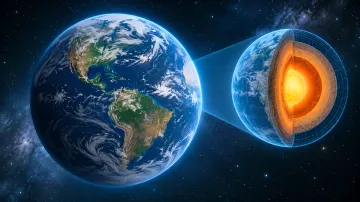
Researchers at the University of Washington have presented a massive computer simulation in which the Earth evolves without any participation from living organisms. The model, published in the specialized journal The Planetary Science Journal, reproduces five billion years of the planet's geological history—from its formation about 4.5 billion years ago to 500 million years in the future. The simulation completely excludes any influence of biota: no bacteria, plants, or animals. Instead, the model tracks the movement of chemical elements between the core, mantle, crust, surface, and atmosphere, allowing scientists to understand what the chemical composition of a 'dead' planet's atmosphere would be like.
From Preliminary Work to a Full-Fledged Model
The project grew out of preliminary work by the laboratory of Astronomy Associate Professor Rory Barnes, who laid the groundwork for modeling the planet's internal processes. Lead author Samantha Gilbert-Janisec expanded the model by adding surface and atmospheric components. As a result, the simulation can reproduce 19 planetary characteristics, including heat flow through the Earth's mantle—a parameter critical for understanding geological activity and chemical exchange between deep layers and outer shells.
Oxygen and Methane as Life Markers
The key idea of the model is that on the real Earth, living organisms continuously replenish oxygen and methane reserves in the atmosphere. These two gases are chemically unstable in the presence of each other: oxygen oxidizes methane, turning it into carbon dioxide and water. Therefore, their simultaneous presence in significant concentrations may indicate that biological processes are constantly restoring their reserves, compensating for the natural reaction. If an observer from another star system analyzed the spectrum of the Earth's atmosphere, precisely this combination of gases could become their primary sign of life.
How the Model Differentiates Geology from Biology
Before astronomers can confidently claim to have discovered life on an exoplanet, they need to rule out an alternative explanation: could such gas combinations form exclusively as a result of volcanic, tectonic, or other geological activity? The new computer model makes it possible to test this assumption. If a simulation completely devoid of life is able to reproduce the observed atmospheric composition of a distant planet, then the unusual combination of gases is explained by natural processes. If the model cannot provide such an explanation without introducing biological factors, the planet becomes a priority candidate for further detailed study.
Preparing for the NASA Habitable Worlds Observatory
The researchers expect the developed model to become a practical tool in preparing future space missions to search for extraterrestrial life. In particular, it can be utilized in designing and calibrating NASA's Habitable Worlds Observatory—a project intended to study potentially habitable planets around other stars. The model does not detect alien life on its own, but creates a 'zero point of reference': a baseline chemical background that a planet should have in the absence of biota. Any significant deviation from this baseline will be a signal requiring close attention. Thus, the digital 'dead Earth' becomes one of the key tools in the arsenal of astronomers striving to answer the question of whether humans are alone in the universe.