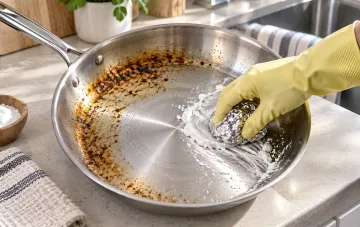
Anyone who has ever cooked in a stainless steel pan has likely noticed unusual shimmers on the bottom — golden, blue, or purple streaks that do not wash away with standard dish soap. This is not a manufacturing defect, rust, or a sign that the cookware is ruined. Behind this effect lies a completely understandable physical and chemical process that cookware manufacturers call heat tint, or thermal coloration of the metal. Let's figure out why it occurs, when you actually need to worry, and how to restore the pan's original appearance without risking damage to the surface.
The Physics of Rainbow Coloration: What Happens to Metal When Heated
Stainless steel contains chromium, which upon contact with atmospheric oxygen forms an extremely thin protective oxide layer on the surface. This is what makes steel "stainless" and protects it from rust. However, when exposed to high temperatures, this layer thickens. Light striking the surface refracts and reflects from the oxide film and the metal beneath it at various angles, resulting in interference shimmers visible to the eye — those very rainbow hues. Cookware manufacturer SEIDO Cookware emphasizes that the phenomenon is purely optical in nature and does not alter the chemical composition or mechanical properties of the metal itself. Rainbow streaks can appear even on a brand-new pan after just the first few uses, especially if food was cooked at high heat intensity.
Is This Dangerous to Health and Can You Continue Cooking?
Made In, a company producing professional kitchenware, explicitly states that blue, golden, and rainbow stains on stainless steel are purely cosmetic. The color change itself does not mean a loss of anti-corrosion properties, the release of harmful substances, or any threat to health. If the bottom of the pan is not deformed and the surface has no physical damage — scratches, chips, dents — the cookware can continue to be used safely. It is important, however, not to confuse heat tint with pitting corrosion. If small depressions or pits have appeared on the metal that do not disappear after cleaning, this is no longer thermal coloration, but a sign of chemical destruction of the protective layer. In this case, you must consult the manufacturer's recommendations for the further use of the specific model.
How to Safely Remove Rainbow Streaks: Proven Methods
The simplest and most affordable method is regular table vinegar. Manufacturer Tramontina recommends precisely this for cleaning stainless steel from thermal streaks and mineral deposits. The key condition is to use regular table vinegar rather than concentrated vinegar essence, which can damage the surface. If the streaks persist after the first treatment, the procedure can be repeated. For stubborn stains, a specialized stainless steel cleaner is suitable — it must be used strictly in accordance with the manufacturer's instructions. An alternative option that also deals with rainbow coloration is a paste made of baking soda and water. It is also used to remove burnt food residues, so it may already be on hand in any kitchen.
What Not to Do: Manufacturer Warnings
According to Le Creuset recommendations, improper cleaning of stainless steel can leave scratches on the surface or permanently damage the oxide layer. Abrasive sponges, metal brushes, and aggressive chemical agents are strictly prohibited. Equally dangerous is a sharp temperature drop: if a hot pan is immediately immersed in cold water, the bottom may warp, and no amount of cleaning will help then. Any cleaning compounds should be chosen based on the surface type: the advice in this review applies exclusively to pans with an exposed stainless steel surface. If the cookware has a non-stick, ceramic, or other special coating, you must strictly follow the instructions of the specific manufacturer.
How to Reduce the Likelihood of Future Streaks
Even with ideal care, rainbow spots can reappear, especially when cooking at high temperatures. Nevertheless, a few simple rules noticeably reduce their frequency. First, preheat the pan gradually on medium heat rather than putting it immediately on maximum heat. Second, do not leave empty cookware on a turned-on burner for a long time — overheating without food accelerates the thickening of the oxide layer. Third, match the burner size to the diameter of the pan's bottom: if the flame extends beyond the bottom, certain areas of the metal overheat unevenly, provoking local thermal shimmers. Adhering to these recommendations does not guarantee the complete absence of rainbow shades, but makes them less pronounced and less frequent.