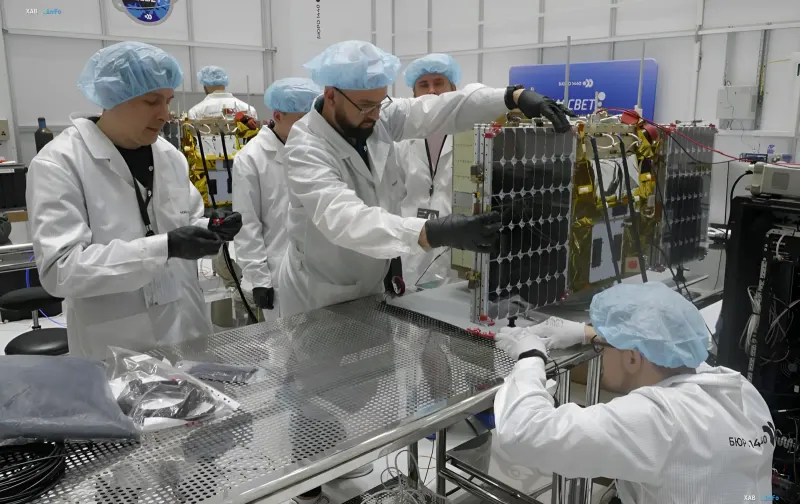
Russia is accelerating the deployment of its own low-orbit satellite communication system «Rassvet», officially positioned as a civilian broadband internet for remote areas, transport, and industry. However, according to an investigation by the Center for Defense Reform, which RBK-Ukraine reviewed, the project has a distinct military dimension and is effectively becoming Russia's response to the American Starlink. In the photo from a clean room, engineers in white coats and protective caps are seen working on the solar panels and onboard equipment of a satellite — with shields bearing the logos of «MegaFon» and «Rassvet» in the background.
From «MegaFon» to a Federal Project
The history of «Rassvet» began in 2020 as a research initiative by the mobile operator «MegaFon». Gradually, the project was integrated into state programs, and in 2025, the operator «Bureau 1440» was formally included in the federal project «Internet Access Infrastructure». According to the authors of the study, the total cost of the program is about $6.1 billion. The core of the system is to consist of 292 low-orbit satellites, as well as ground control infrastructure, gateway stations, and user terminals. The federal plan provides for the launch of a total of 383 units in 2025–2030: 292 for the main constellation and another 91 as replacements.
The Military Dimension of «Rassvet»
The Center for Defense Reform points to a number of signs of dual use of the system: communication between command posts and forward positions, coordination of artillery and aviation, exchange of reconnaissance and cartographic information, maintaining communication during movement, and controlling unmanned aerial vehicles. The authors of the study note that in June 2026, Vladimir Putin effectively acknowledged the use of «Rassvet» for controlling UAVs at the front. Furthermore, according to their assessment, the system could be used to improve the accuracy of the Russian GLONASS navigation system.
Who Stands Behind the Facade of a Private Company
Formally, the project is implemented by the private company «Bureau 1440», but according to the investigation, behind this facade stand the resources of the large X Holding conglomerate, ties with intelligence agencies, support from «Roscosmos», personnel from the Russian space industry, and a production network of more than 1300 companies. Publicly, Moscow calls «Rassvet» a «sovereign response» to Starlink, however, the real architecture of the project relies on state and corporate resources, not just private capital.
Behind Schedule and Plans for 2026–2027
The deployment of the system is already lagging behind the initial schedule: the first units were planned to be put into orbit in 2025, but the first batch of 16 satellites was launched only in March 2026, and one of them subsequently left orbit. The second launch took place on July 19, 2026, and according to specialized services, also included 16 units. After this, the constellation numbered 31 satellites. The General Director of «Bureau 1440», Alexey Shelobkov, stated that 2026 should become the stage of experimental operation and testing of the system in real conditions. By the end of 2026, Russia intends to bring the constellation to 156 satellites, and in 2027 — to start commercial operation.
Contradictory Data
There are discrepancies in open sources regarding estimates of scale and timing. According to the study by the Center for Defense Reform, by the end of 2026 the constellation should reach 156 units, which, according to the authors, is already enough to support communication and data transmission in a limited mode, while a full transition to practical use is possible only in early 2027. At the same time, as follows from the statement cited by Ukrainian media (Nasonov), by 2027 there is already talk of 300 «Rassvet» satellites, which allegedly will be able to «fully control» Ukraine. These figures and the nature of the threat differ significantly: the first estimate is based on confirmed launches and the federal plan, the second — on forecast and largely evaluative statements. Moreover, the originally announced launch dates (2025) did not match the actual ones (March 2026), which confirms the systematic lag of the project from the schedule.
Weaknesses of the System
One of the key vulnerabilities of «Rassvet» is dependence on foreign components, Chinese supply channels, and Western equipment, access to which is preserved despite sanctions. It is from this dependence that Moscow declares its desire to get rid of, but at the current stage it remains a structural problem of the project. The coming months will show whether «Bureau 1440» will be able to regularly launch new units and quickly increase the constellation, which will determine whether «Rassvet» will turn into a practically usable satellite communication system for military needs or remain at the stage of long-term tests.