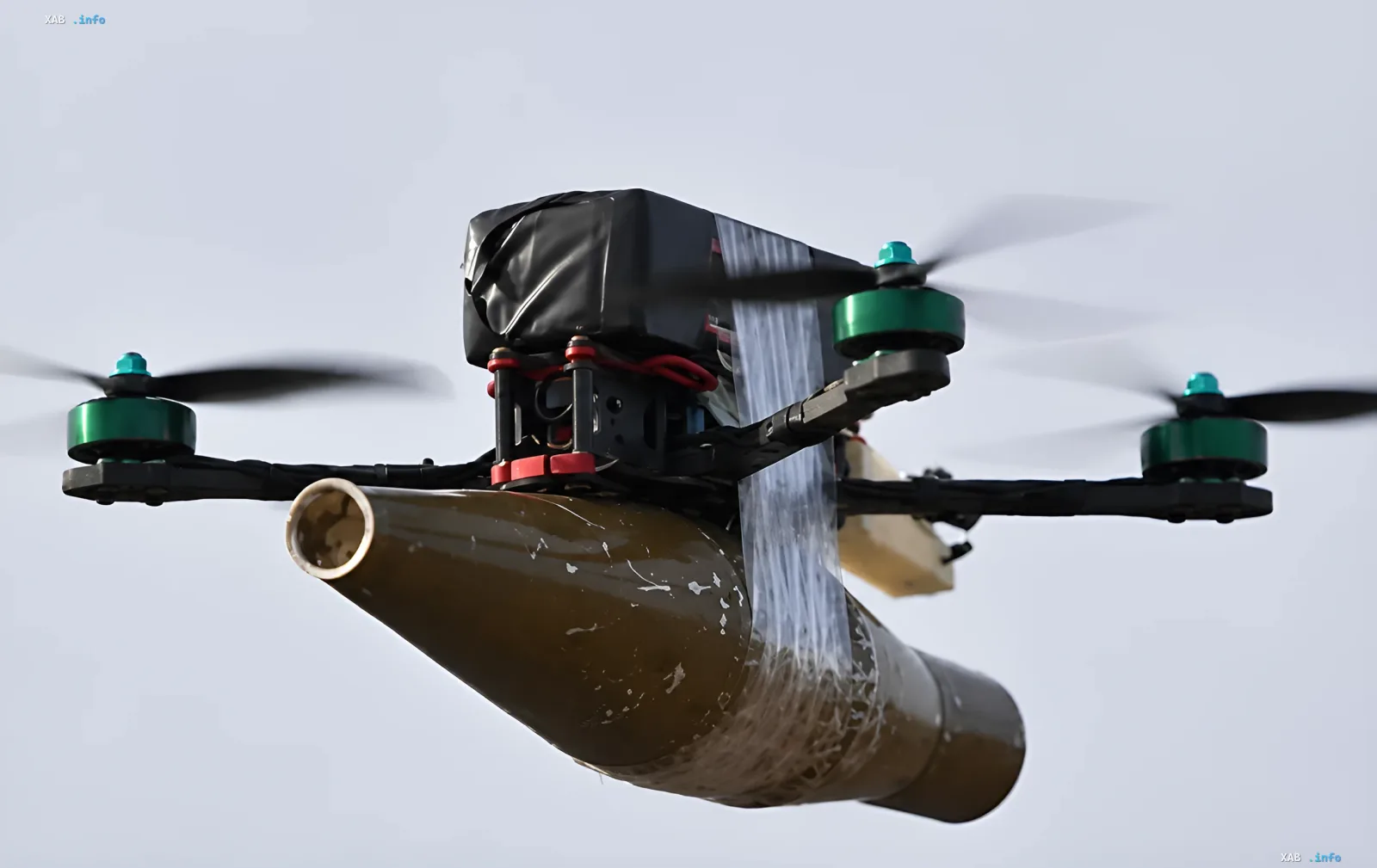
Ukrainian electronic warfare (EW) is increasingly facing an adversary that deliberately changes the architecture of its unmanned systems to reduce the effectiveness of jamming. This was explained in an interview with RBC-Ukraine by Tymofiy Yurkov, co-founder of EW manufacturer Contra-Drone. According to him, one of the key trends in recent times has been the gradual increase in the share of fiber-optic drones in the Russian adversary's arsenal. This data transmission channel is fundamentally independent of the radio frequencies on which the vast majority of EW systems operate, making interception significantly more difficult. In parallel, Yurkov assesses that Russia is changing the frequencies on which its drones operate, adding new ranges and thereby expanding the spectrum that Ukrainian systems must cover.
The Evolution of CRPA Antennas: From Four Channels to Twenty
A separate vector of evolution concerns the navigation systems of large unmanned aerial vehicles, above all the Shaheds. Russia is steadily increasing the number of modules in CRPA antennas for GNSS navigation — a technology that allows the antenna to form directed "nulls" toward interference sources and thereby maintain signal reception even under electronic noise. Yurkov emphasizes that at the start of the full-scale war such antennas did not exist: ordinary GPS receivers were used, which were suppressed by electronic noise at the corresponding frequency. "The first CRPA antennas were four-module. Then eight-channel, 12-channel, and 16-channel systems appeared. Currently, according to our information, the Russians have purchased large batches of 20-channel systems in China," he explained.
Protecting Energy Facilities: The Need for Multi-Module Systems
According to Contra-Drone, the growth in the number of channels in navigation antennas has a direct impact on the design of protection for critical infrastructure. To counter such systems, it is necessary to increase the number of navigation jamming means, since each additional antenna requires expanding the spectrum and power of suppression. "Around energy facilities, a large multi-module system needs to be created to timely jam the navigation channels of missiles, glide bombs, and Shahed-type drones," Yurkov noted. Thus, the expansion of CRPA antennas shifts the protection of the energy system into a race over the number and power of jamming modules.
AI Terminal Guidance for FPV: A New Threat and Its Limits
Another emerging threat, according to Yurkov, is the use of artificial intelligence for terminal guidance of FPV drones onto a vehicle target. In such a scheme, the operator first acquires the target, after which the drone continues guidance automatically. The fundamental problem for EW is that after guidance is handed over to the AI module, the effectiveness of jamming may decrease, although at the current moment, according to his interlocutor's assessment, such cases are not yet frequent. At the same time, the automatic terminal guidance system retains significant shortcomings: the drone often loses the target, especially when the vehicle is moving across terrain without pronounced visual contrast. "The system is not yet sufficiently developed, but we see significant changes and understand that it will continue to develop," Yurkov concluded.