Water on the Moon is not just a scientific curiosity but a fundamental prerequisite for creating a sustainable space economy. Without access to local resources, any missions to Earth's satellite, Mars, and further into the solar system will remain extremely expensive and limited. This is why American geophysicists have developed a fundamentally new method for detecting hidden water ice reserves, capable of finding them at depths of up to 800 meters.
Ice Changes Soil Stiffness
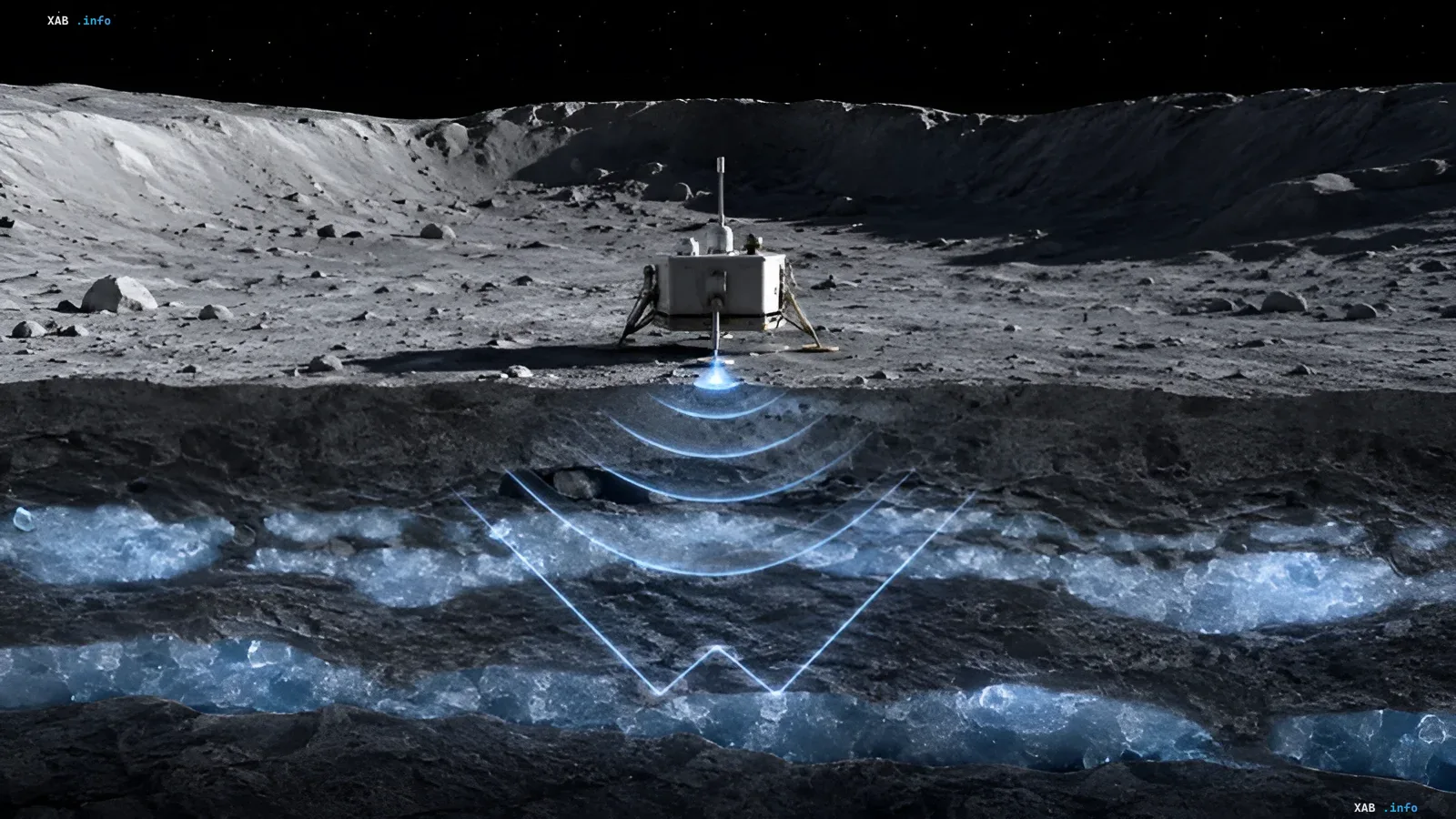
The new methodology, described in a recent publication, is based on the physical properties of lunar soil (regolith). Scientists have proven that ice-saturated regolith possesses significantly greater stiffness than dry soil. This property directly affects the propagation of seismic waves: in icy layers, their speed can increase by two to three times.
Furthermore, the boundaries between soil and ice layers act as reflectors for seismic energy. By analyzing these reflections and changes in wave arrival times, researchers will be able not only to detect deposits but also to approximately estimate their volume.
A Laboratory Under a Synchrotron
To confirm the theory, a group of scientists conducted a series of experiments simulating conditions on the Moon. Crushed volcanic rock from Arizona was used as an analog for lunar soil. Samples were placed in a cryogenic vacuum chamber, cooled, and studied using a synchrotron X-ray beamline.
Micro-tomography allowed for detailed observation of how water fills microscopic pores between soil particles and how this alters its deformation under conditions of extremely low temperatures and vacuum. The obtained data formed the basis of a physical model of the elastic properties of frozen lunar regolith.
From Temperature Maps to Seismic Waves
The next step was combining laboratory data with computer modeling. Scientists overlaid the results onto temperature maps of the Moon's south polar region. This allowed them to identify craters where ice could have been preserved for billions of years in conditions of permanent shadow.
Seismic modeling demonstrated how waves would refract and reflect from underground layers. Importantly, the developed system is capable of distinguishing deposits of different origins and structures, providing a precise understanding of the nature of the resources.
Wave Sources and Future Missions
In practice, artificial explosions are not necessary for exploration. Sources of seismic waves can be natural moonquakes, meteorite impacts, or even the operation of drilling units on landers and rovers. Special seismometers or sensitive accelerometers installed on the surface will record the soil's response.
This method is critically important because orbital spectrometers are capable of investigating primarily the upper surface layer, leaving deep deposits inaccessible to observation.
Who Will Test the Theory First?
The first opportunity to test the new methodology in practice will appear soon. By the end of this year, the Chinese 'Chang'e-7' mission will launch to the Moon, delivering the first modern seismic activity sensor to the surface. Later, as part of the return-to-the-Moon program, astronauts will install their own seismic instruments, planning a landing in 2028 or later.
The search for water in the vicinity of the Moon's south pole will be a priority, as the composition of volatiles from this region may preserve unique information about the delivery of water to the inner Solar System billions of years ago.