The outer part of the Solar System may become unstable not in 1018 years, as previous estimates suggested, but approximately one billion years after the Sun turns into a white dwarf. New work by Konstantin Batygin from the California Institute of Technology (Caltech) shows that previous calculations underestimated an important factor: the Sun will not lose mass smoothly, but through separate asymmetric ejections. In this case, changes in planetary orbits will lead to their random wandering, gradually destroying the current architecture of the outer system. The previous picture was much calmer.
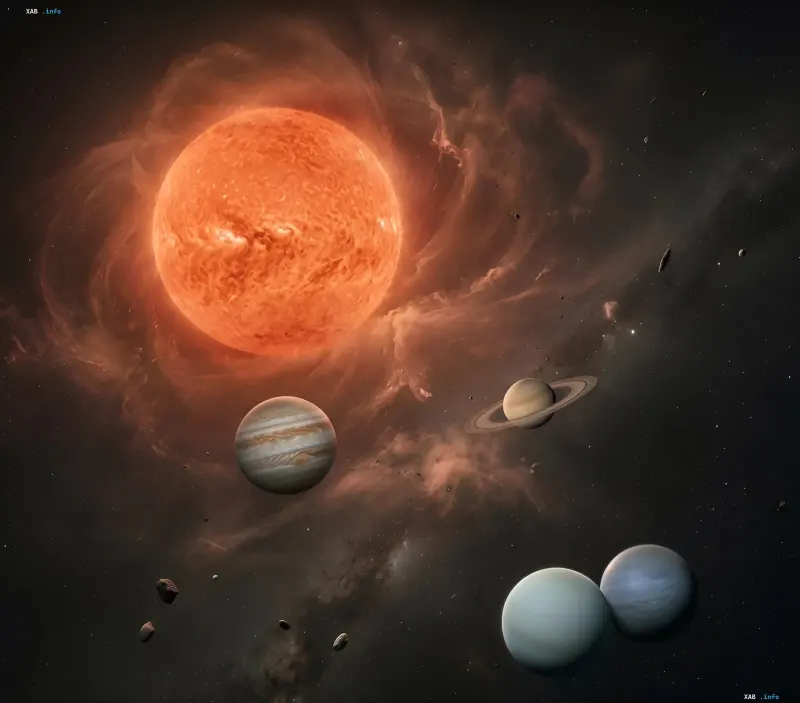
As it ages, the Sun will shed about 46% of its mass, and planetary orbits during smooth mass loss will expand by about 1.85 times, while maintaining their relative configurations. In numerical experiments by Batygin and his co-authors, such a scenario truly leaves the orbits of Jupiter, Saturn, Uranus, and Neptune stable over very long times. Therefore, it was believed that after the Sun turns into a white dwarf, the giant planets could exist for another 100 billion years, and the inherent dynamical instability of the outer system was estimated at ~1018 years.
Asymmetric Ejections and Random Wandering
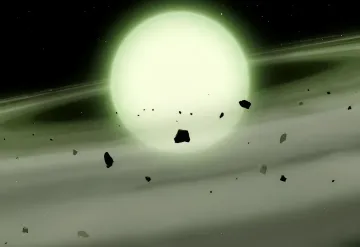
However, mass loss by a star can occur differently. Archives of observations of young white dwarfs indicate that when shedding its outer envelope, the star receives a small recoil velocity of about 0.75 km/s. One possible mechanism explains this by many separate ejections of matter occurring at different times and in different directions. Each such ejection gives the star a small impulse, but many impulses add up to a random walk.
Since the Sun's gravitational field dictates the orbits of all planets, each perturbation will slightly alter their orbital motion. As a result, small perturbations will accumulate and reinforce each other instead of averaging out. This is exactly what the authors of the work tested using numerical calculations of the motion of four giant planets based on models of stellar evolution.
Simulation Results and the Fate of Giant Planets
With a very small mass of individual ejections, the system behaves almost the same as with smooth mass loss. But at values on the order of 10-5 solar masses and higher, orbits begin to noticeably rearrange. In the calculations, orbit collisions began even during the red giant stage: in nearly 40% of realizations, the outer Solar System experienced destruction or strong scattering before the white dwarf formed. Overall, nearly 90% of the simulated systems collapsed within the first 3 billion years of its formation.
At the same time, destruction does not necessarily mean planet collisions. When orbits cross, giants can gravitationally scatter each other, change their order, or be ejected from the system. In individual calculations, Saturn left the system in just a few million years, Uranus and Neptune swapped places, and planetary perihelia shifted enough to cross Jupiter's orbital region. Simultaneously, random perturbations sometimes captured pairs of planets into orbital resonances, though this did not serve as protection.
Contradictory Data
While classical astrophysical models relied on the concept of a smooth and symmetric reduction of the central luminary's mass, implying the secular existence of the outer planetary system for quintillions of years, new empirical data from observations of young white dwarfs and modern numerical experiments demonstrate a fundamentally different chaotic scenario. Discrepancies in estimates of the system's lifespan span billions of times, forcing a revision of established paradigms in stellar dynamics.
For Earth, this result changes almost nothing: long before the white dwarf forms, the Sun will pass through the red giant stage, rendering the modern planet uninhabitable. Nevertheless, Konstantin Batygin's research fundamentally alters the foundational understanding of the final fate of the entire Solar System.