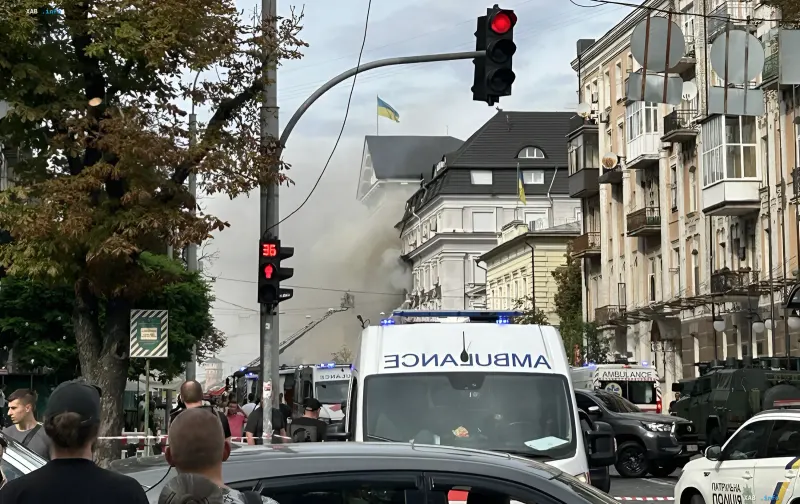
On September 4, 2026, one of the most high-profile events of the entire war took place in the center of Kyiv: a Russian jet-powered drone struck the building of the Security Service of Ukraine (SBU), and, according to Ukrainian media and as confirmed by the BBC, the drone hit the office of SBU head Oleksandr Poklad directly. Emergency services immediately carried out large-scale operations at the scene — in footage shot by witnesses, one can see 'Ambulance' vehicles with their beacons activated, fire crews, military trucks, and a dense crowd of citizens observing the perimeter tape stretched around the area. A column of special vehicles and the smoke rising from behind the roofs of historic buildings against the backdrop of the Ukrainian flag became a visual symbol of how close the aerial threat had come to key state institutions.
Debris analysis: 'Geran-4' confirmed by most elements
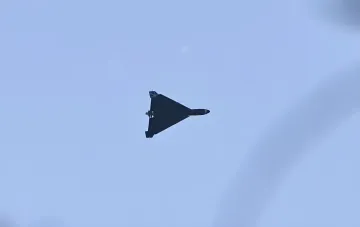
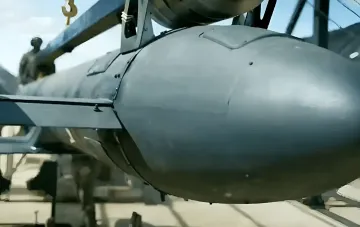
Within hours of the strike, Ukrainian presidential adviser for the development of defense technology directions, Serhiy "Flash" Beskrestnov, published a statement on Facebook with the results of the preliminary analysis of the debris of the downed/target-striking drone. According to him, Ukrainian specialists established that the fragments belong to the 'Geran-4' modification — the Ukrainian designation for the Iranian Shahed-family strike UAV. "We have already examined the debris and established that it belongs to the 'Geran-4', including most of its elements," Beskrestnov emphasized. This made it possible not only to identify the type of aircraft but also to reconstruct its configuration, which is significant for the further operation of air defense systems and for understanding the enemy's tactics in employing jet-powered drones.
Flight route: two drones from the Donetsk direction, altitude above 7 kilometers
A separate section of Beskrestnov's statement is devoted to surveillance system data. According to him, all Ukrainian air-target tracking systems recorded the route of the jet-powered drone heading from the Donetsk direction toward Kyiv at an altitude of more than 7 kilometers. This substantially refutes the claim of a "small" or "consumer" drone that was being spread in Russian social media pages immediately after the attack. Moreover, Beskrestnov revealed a detail that had not previously appeared in open reports: as part of the same operation, two jet-powered UAVs were sent to the capital, flying in a pair. "By the way, during this special operation against the SBU, two jet-powered UAVs were flying to Kyiv in a pair. One of them made it," he noted. Thus, the Ukrainian side has information about the launch direction, the paired nature of the sortie, and the fact that the second aircraft was intercepted or lost en route.
Contradictory data
Immediately after the attack, a version actively circulated in Russian social networks and Telegram channels that the strike on the SBU was staged using a small drone, and that there had been no real external strike. According to Beskrestnov, Ukrainian surveillance systems do not confirm this version: what was recorded was precisely a jet-powered drone at high altitude with a clear route from the depths of the occupied territories. In parallel, a number of Russian aggregators, in particular Rambler News, published a piece with an ironic headline about the "mutual destruction" of Ukrainian security services "without Russia's involvement," which is essentially a retelling of the propagandist narrative of a "staged event." Meanwhile, Ukrainian officials, including Foreign Minister Andriy Sybiha, characterized the incident as a real and serious escalation. Thus, the reader is presented with two versions: the official Ukrainian one, backed by air defense data and debris analysis, and the Russian propagandist one, based on denying the fact of an external strike. Independent international verification of the type and configuration of the UAV is not currently available in open sources.
Diplomatic reaction and the significance of the attack
Ukrainian Foreign Minister Andriy Sybiha called the strike on the SBU building a "serious escalation of the war" and stated that it testifies to Moscow's complete abandonment of the diplomatic track. The choice of target — the office of the head of the country's main counterintelligence agency — gives the attack not only a military but also a symbolic character: it is a matter of an attempt to demonstrate the ability to strike key state institutions in the very center of the capital. Against the backdrop of the fact that, according to Beskrestnov, the drone flew at an altitude of more than 7 kilometers from a direction hundreds of kilometers away, the incident underscores both the achieved level of development of Russia's drone attack and the persisting vulnerabilities in Kyiv's air defense system at high altitudes.
What is known at this point
As of September 5, 2026, no official data on casualties among SBU staff has been published in open sources. According to Beskrestnov, the debris analysis has already been completed in terms of identifying the type and configuration of the UAV. The question of whether the second drone was shot down by air defense means or lost for other reasons is not clarified in the presidential adviser's statement. Judging by the Foreign Ministry's reaction, Ukrainian authorities intend to use the incident in the diplomatic arena as an argument in favor of completely canceling any forms of negotiation process with Moscow. The further dynamics — the publication of a detailed SBU report, possible statements by Poklad, and the reaction of international partners — will determine whether this strike becomes a turning point in how Ukrainian society and Western capitals perceive the level of threat aimed directly at the country's top leadership.