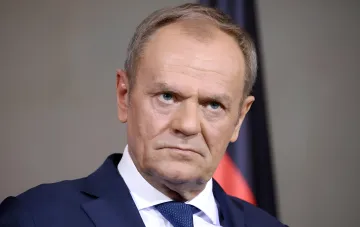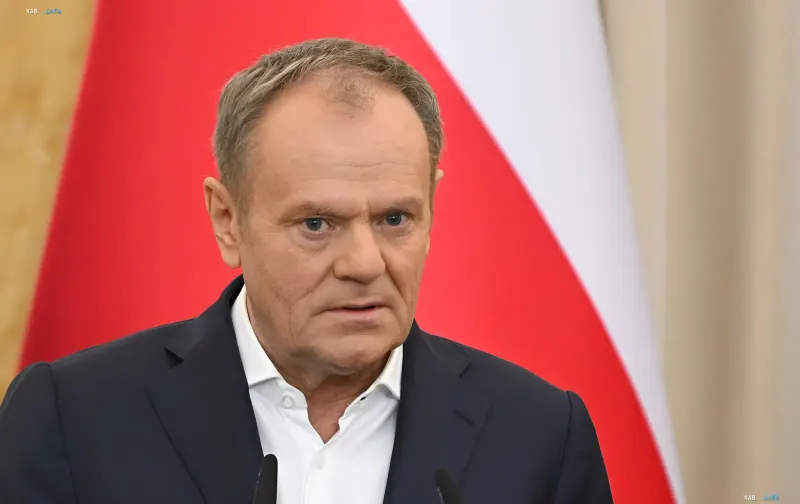
Polish Prime Minister Donald Tusk issued a sharp warning about the growing security threats in Europe, stating that signals from Russia indicate serious preparations for further escalation of the conflict. In his words, the next seven to eight months could become a turning point for the security of Ukraine, Poland, and the entire region. The statement came against the backdrop of Russia's ongoing war against Ukraine and the sustained high level of threats in the European space, RBC-Ukraine reports, citing Ukrinform.
Signals of preparation for escalation
Tusk drew attention to a combination of factors that, in his assessment, indicate that Moscow is deliberately laying the groundwork for a new wave of intensification. The prime minister emphasized that the available signals cannot be ignored and that the possible development of events must be treated with the utmost seriousness. His rhetoric focuses not on isolated incidents but on the systematic preparation by the aggressor, which implies the need for accelerated decision-making by European capitals in the fields of defense and diplomacy.
Critical window: autumn and winter of 2026–2027
The phrase "the next 7–8 months" is counted from the end of August 2026 and covers the period from September 2026 to April–May 2027. It is precisely this time corridor that, according to the Polish prime minister's assessment, will determine the further trajectory of security in Central and Eastern Europe. Tusk did not stop at merely stating the threat: he explicitly declared that Poland and its allies must be ready for scenarios that go beyond the current confrontation, and that delaying defense decisions could cost dearly.
Context: warnings from Washington and signals from the Kremlin
Tusk's statement came in a dense informational context. The day before, CIA Director John Ratcliffe publicly warned Moscow of the dangers of further escalation in Ukraine, indicating that American intelligence is tracking the same trends that Warsaw refers to. In parallel, it was recently reported that the Kremlin does not rule out the continuation of escalation, and that some Russian officials, according to sources, are already considering the possibility of using nuclear weapons as a last resort. The combination of these signals paints a picture in which diplomatic space is shrinking and military pressure is growing.
Contradictory data
Open sources show discrepancies in assessing the scale and timing of the threat. On the one hand, Tusk operates with a specific time horizon of 7–8 months and speaks of "signals" of preparation for escalation, which implies the existence of intelligence data confirming Moscow's deliberate actions. On the other hand, the Kremlin does not publicly confirm preparations for a new wave, and statements about the possible use of nuclear weapons remain in the realm of "not ruled out" and "a last resort," which can be interpreted as rhetorical pressure rather than an operational plan. Thus, one side interprets the situation as preparation for specific actions, while the other sees it as a demonstration of readiness. The gap between these two frameworks remains unresolved and requires further verification through intelligence and diplomatic channels.
Regional consequences and Poland's position
For Poland, whose borders with Belarus and Ukraine make it a NATO frontier state, Tusk's warning is not merely declarative but also practical. Earlier, the prime minister explained why Warsaw does not intend to transfer Patriot air defense systems to Ukraine, citing its own defense needs. In a situation where, in his words, the critical window has already opened, the question of allocating defense resources between supporting Kyiv and defending its own borders becomes central to Polish policy. Tusk is thus preparing public opinion for a possible hardening of the course and an increase in defense spending in the coming months.