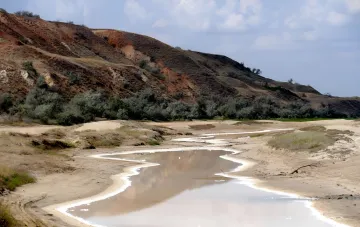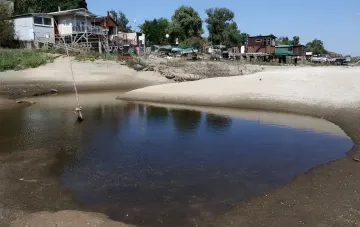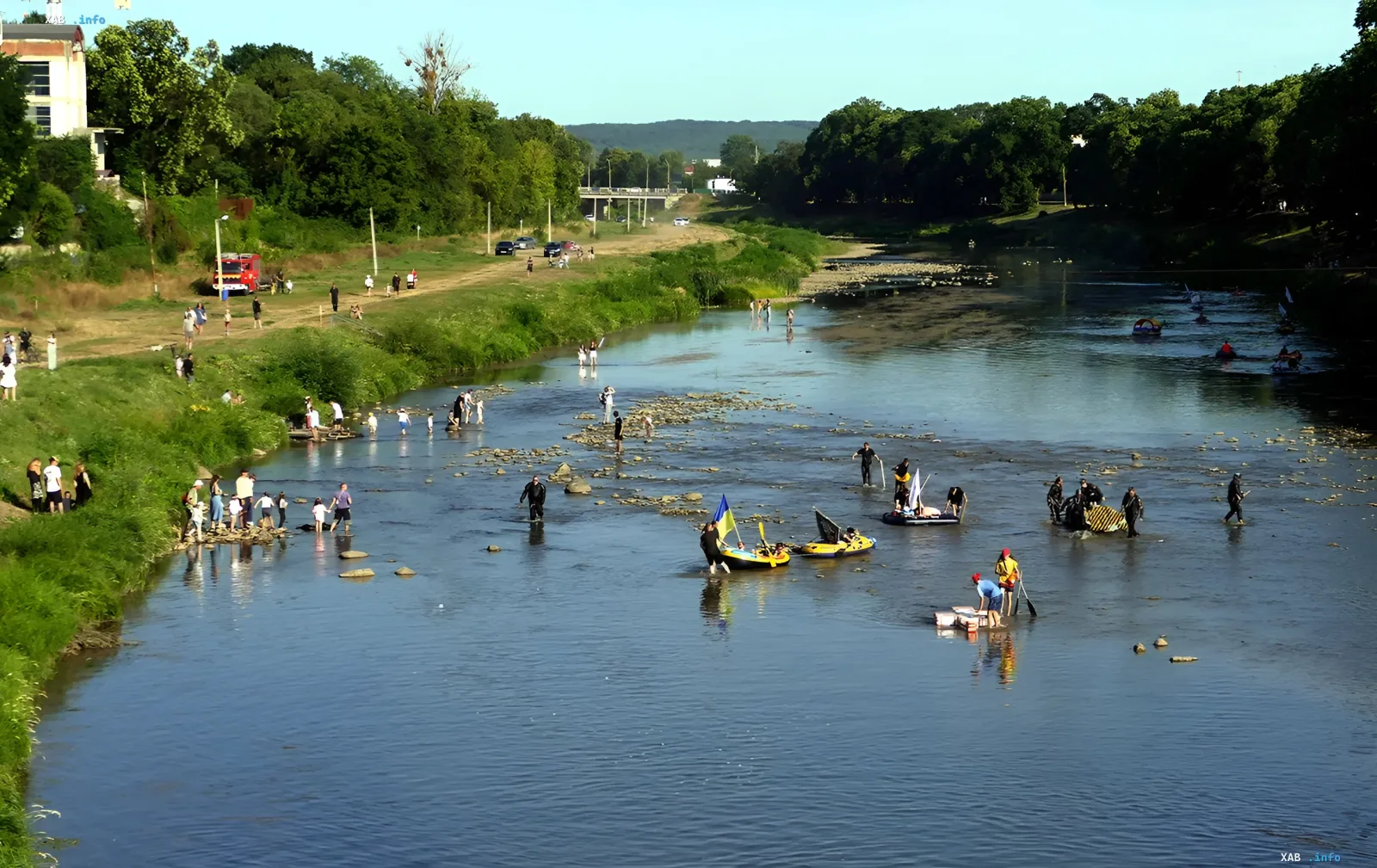
At the end of August 2026, the Ukrainian Hydrometeorological Center (UkrHMIC) issued a warning about adverse hydrological phenomena for a number of regions. According to the center's press service, between 26 and 31 August, water levels on certain rivers will continue to decline — down to the lowest values recorded over the entire period of observations. Specialists clarified that this refers to a reduction in river flow to low-water criteria, for which a Level III danger — the 'brown' level — has been introduced in the relevant regions. The photo shows a typical scene of a dried-up riverbed, where people wade across the bottom and small watercraft operate in the shallows.
What exactly was announced by UkrHMIC
The center warned that the drop in water levels is sustained and remains at critically low marks. In the conclusion of its message, the hydrometeorological center emphasized that on certain stretches of small rivers, the decline in flow may lead to a complete absence of runoff. According to specialists' assessment, this will 'complicate the functioning of the water management complex' — that is, it will directly affect water supply, the operation of hydraulic structures, and the industries linked to them.
Which rivers and basins are at risk
The warning primarily concerns rivers in the Dniester basin. A similar situation is being recorded on rivers in the Sian sub-basin in Lviv Oblast, as well as on rivers in the Western Bug sub-basin. Thus, the zone of critical low water covers several hydrological regions in the western and southwestern part of the country, where flow during the dry season falls below the values customary for this time of year.
What the 'brown' danger level means
According to the List of Hydrological Phenomena of I, II, and III Danger Levels on Terrestrial Water Bodies of Ukraine, 'brown' is the highest level signaling low water levels, i.e., critical deficit and low flow. In practice, it is characterized either by water levels dropping below established thresholds, or by a decline during the dry season below the lowest marks over the entire observation period, with such a state persisting for a month or more. In essence, this is a factual drought or significant shallowing of rivers, in which there is so little water that it interferes with the normal operation of infrastructure and can be critical for ecosystems.
Difference from the 'red' level and practical consequences
It is important not to confuse the 'brown' level with the 'red' level: both belong to Level III of danger, but 'red' signals the opposite situation — an excess of water and flooding, whereas 'brown' signals a deficit. For the population and the economy, shallowing means risks to water supply, navigation, and the operation of the water management complex, while for nature it means stress on aquatic ecosystems during a period of already low flow. The hydrometeorological center continues to monitor the dynamics of water levels and to refine its warnings as the situation changes.