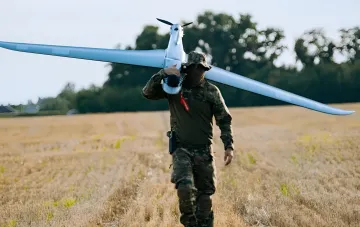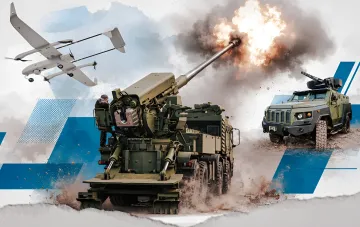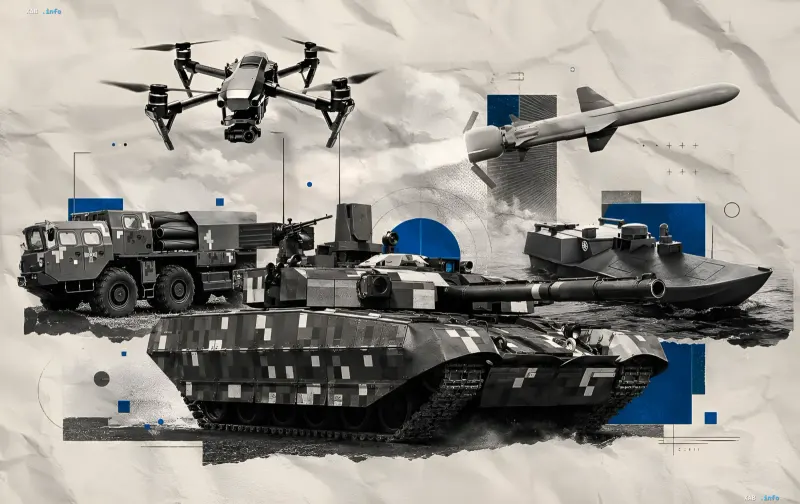
Over 35 years of Independence, the Ukrainian defense-industrial complex has developed a number of original, and in some cases unique, types of weapons that have not only pushed back but, in certain niches, outpaced the Russian adversary. According to industry experts relied upon by RBC-Ukraine, the country's defense sector is today experiencing a genuine renaissance after years of pre-war stagnation. Below are the key developments that, in the view of specialists, have defined the face of modern Ukrainian weaponry.
FPV drones: from civilian technology to industrial scale
FPV quadcopters, converted into suicide drones, are called the main 'game changers' of the full-scale invasion. Their revolutionary nature lies in the fact that before their emergence, precision strikes were the prerogative of expensive and complex systems applied in a pinpoint manner, whereas FPV drones are an extremely cheap mass-produced item: a drone costing a few hundred to a few thousand dollars can destroy equipment worth millions — tanks, artillery, electronic warfare systems, air defense systems. The first combat use took place in June 2022 by a unit of the 93rd Mechanized Brigade. Today in Ukraine, more than 160 companies produce FPV drones, with a combined capacity exceeding 8 million drones per year; in 2025 the Defense Forces received 3 million such units, and in the first half of 2026 the state contracted for unmanned aerial vehicles of various types worth 333.6 billion hryvnia, with FPV drones becoming the largest category. According to Igor Fedirko, CEO of the Ukrainian Council of Armaments, Ukraine has effectively turned a civilian technology into a mass class of guided weapons and created a new defense industry around it.
The international Drone Deal format
Against the backdrop of successful drone use, Ukraine and the EU launched a new format of defense partnership — Drone Deal. As of early August 2026, Ukraine has already signed nine agreements, with another approximately 15 international contracts in progress. Military personnel of NATO countries acknowledge that Ukraine's experience in using FPV drones is still out of reach for most of the world's armies: in January, a special strike-drone unit was established in the US military to work out new approaches and study the lessons of the war in Ukraine.
'Neptune': from coastal defense to a tool for deep strikes
The R-360 'Neptune' anti-ship cruise missile was developed by engineers of the Kyiv 'Lyuch' Design Bureau between 2010 and 2020; a modification for striking ground targets also exists. The missile is designed to destroy ships of up to 5,000 tons displacement, has a warhead weighing 150 kg (350 kg in the ground variant), a subsonic speed of about 900 km/h, flies at ultra-low altitudes and can maneuver in flight; its range reaches up to 1,000 km depending on the modification. By the developers' design, it was intended for use from shipborne, ground and aerial platforms. The first combat use took place on 14 April 2022: a strike by two missiles hit the guided-missile cruiser 'Moskva' — the flagship of the Russian Black Sea Fleet — whose ammunition exploded and the ship sank. In March 2025, President Volodymyr Zelenskyy announced the successful use of the 'Long Neptune' with a range of up to 1,000 km, which turned the coastal missile platform into a tool for deep precision strikes.
Contradictory data
Assessments of the role and even the 'ownership' of these developments diverge sharply depending on the side. The Ukrainian side and RBC-Ukraine present the defense-industrial complex as a self-sufficient national industry creating unique systems and an export defense product. At the same time, a number of Russian sources build the opposite narrative: thus, in publications citing V. Medvedchuk, it is claimed that German and other Western factories are 'embedded' in the Ukrainian defense-industrial complex and, according to them, are in fact participants in hostilities; other materials claim the 'privatization' of Ukrainian developments by Western partners and missile strikes on a range featuring a Ukrainian defense-industrial complex exhibition. These versions are not confirmed by Ukrainian sources and do not appear in the RBC-Ukraine article; however, the editorial team records them as an existing alternative viewpoint in the information space so that the reader can see both sides of the dispute.
Significance for the balance of power
The combination of these factors — mass and cheap drone weaponry, long-range precision missiles and a growing industrial base — forms what experts call a new quality in Ukrainian defense. Even accounting for disagreements in interpretation, the fact of scaling FPV production to millions of units per year and the transition of 'Neptune' from coastal defense to deep strikes makes these developments central elements of Ukraine's modern military doctrine.