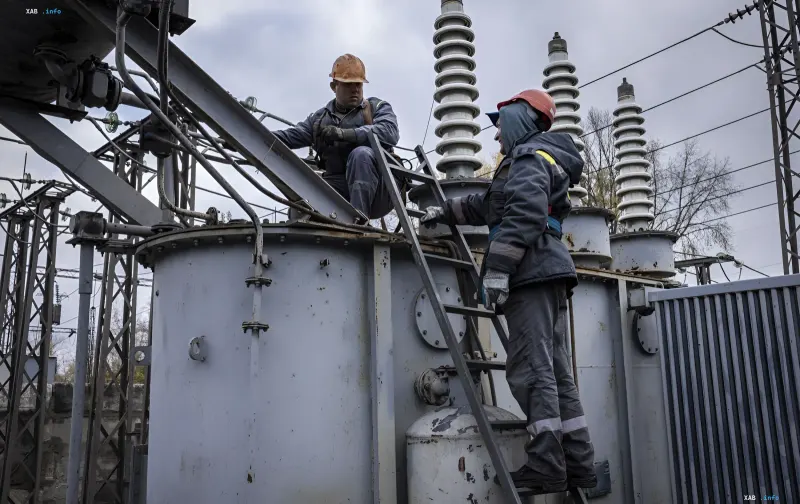
Ivan Yurik, a member of the management board of the national energy company Ukrenergo, stated that Russia has changed its tactics for striking electrical substations in Ukraine. According to him, the main substation equipment is sufficiently well protected, so the enemy has stopped aiming at it directly and shifted to strikes on large open areas. This was reported by RBC-Ukraine, citing Ukrinform. The photo accompanying the article shows emergency crews working on substation equipment — these are the very crews that, according to Yurik, are forced to restore the consequences of massive attacks under extreme conditions.
From pinpoint missile strikes to area-wide attacks
Yurik recalled that in previous years, Ukraine's critical infrastructure was primarily targeted by cruise and ballistic missiles. Now, in his assessment, the enemy has gained additional capabilities due to the mass production of jet drones. A key factor in the change of tactics, according to the Ukrenergo representative, is the speed of restoration: without follow-up strikes, emergency crews manage to eliminate a significant portion of damage from missiles and drones in two to three hours. "The goal is to waste the time we spend on restoration," Yurik explained. That is why, according to him, Russia shifted from pinpoint attacks on primary equipment to strikes on large areas, often using cluster munitions that explode above the substation territory.
What is protected and what remains vulnerable
According to Yurik, autotransformers — the most valuable substation equipment — are well protected, which is why the enemy is trying to disable as much secondary equipment as possible. "The enemy is attacking large areas of open distribution networks, including breakers, relays, and current and voltage transformers. Unfortunately, after such attacks, it takes a lot of time to restore," noted the Ukrenergo representative. Thus, he estimates that strikes on open switchgear cause damage that requires significantly more time and resources to fix than damage from single pinpoint hits.
International support and emergency stocks
Despite the extreme conditions, Ukraine manages to maintain the power system thanks to the experience and dedication of repair workers, as well as the emergency equipment reserves accumulated over previous years and constant technical and financial support from international partners. Yurik reported that since the beginning of 2022, Ukrenergo has received more than a billion euros in donor aid alone — including from USAID, the World Bank, the EBRD, and German, French, and Japanese partners — and even more in credit support. The funds received, he said, are primarily invested in replenishing the emergency equipment stock.
Two systemic restoration problems
Among the main difficulties in restoring the power system, Yurik highlighted two factors. The first is the supply of high-voltage equipment: there are few manufacturers in Ukraine and the world, so orders take a long time to fulfill. The second is a shortage of system contractors capable of performing physical protection and restoration work on energy facilities. Both of these limitations essentially determine how quickly emergency crews can return damaged sections of the grid to operation after subsequent attacks.
Context: strike intensity and regional situation
According to data previously provided by the Ukrainian Ministry of Energy, Russia has attacked energy and oil and gas facilities 100 times over the past week. The most difficult situation, according to First Deputy Minister of Energy of Ukraine Artem Nekrasov, is in the Odesa and Dnipropetrovsk regions. Separately, RBC-Ukraine noted that electricity bills may not decrease even during blackouts: energy experts from Yasno identified two reasons — untimely meter readings and delayed consumption after the power supply is restored.