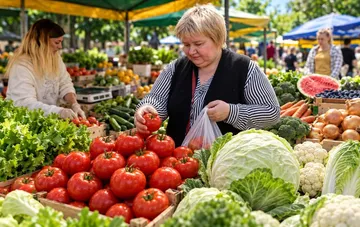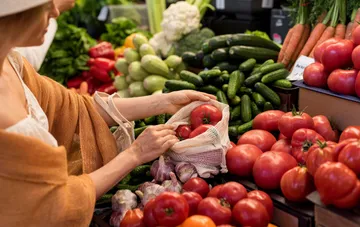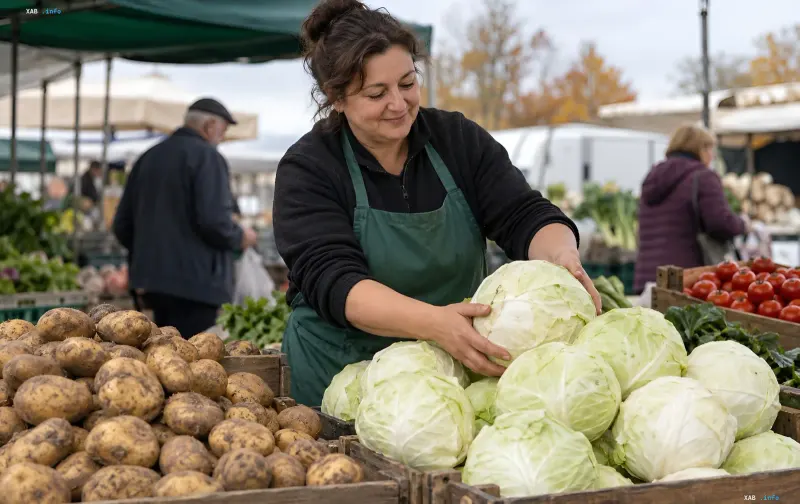
In the middle of October, mixed price dynamics were recorded in the Ukrainian food market: against the background of increasing supply, white cabbage, potatoes, and cucumbers fell in price, while tomatoes continued to rise in price, and in the fruit segment, grapes noticeably increased in value. Such data for the week of October 9 to 16, 2026, are provided by the EastFruit analytical project, referenced by RBC-Ukraine. The changes turned out to be uneven: some positions of the borsch set lost in price against the background of increased supply, while others, on the contrary, expanded the price range upwards.
Borsch set vegetables: cabbage, potatoes, and cucumbers became cheaper
The most noticeable was the decrease in the cost of white cabbage: over the week, the range dropped from 17–20 to 16–18 hryvnias per kilogram. In parallel, potatoes became cheaper — from 11–14 to 10–13 hryvnias per kilogram, and cucumbers, according to EastFruit, unexpectedly for the market decreased from 50–65 to 40–60 hryvnias per kilogram. A similar trend was shown by other vegetables: zucchini fell in price from 30–35 to 25–30 hryvnias, eggplants — from 45–60 to 40–55 hryvnias, cauliflower — from 50–60 to 40–50 hryvnias per kilogram. The price range for sweet peppers narrowed from 30–65 to 45–60 hryvnias per kilogram.
Tomatoes are getting more expensive, greens show mixed trends
Against the background of the general cheaper pricing of some vegetables, tomatoes, on the contrary, became more expensive: if a week earlier they were sold at 55–65 hryvnias per kilogram, by October 16 the upper limit of the range rose to 75 hryvnias (55–75 hryvnias per kilogram). Among greens, the dynamics also turned out to be mixed. Green onions rose in price — from 60–100 to 115–125 hryvnias per kilogram, while dill fell in price from 175–185 to 155–165 hryvnias, parsley — from 125–135 to 115–125 hryvnias, and lettuce — from 100–120 to 80–100 hryvnias per kilogram. At the same time, a number of positions maintained previous prices: beets remained in the range of 13–15 hryvnias, Beijing cabbage — 30–35 hryvnias, radishes — 45–50 hryvnias, garlic — 70–180 hryvnias per kilogram.
Fruit segment: grapes get more expensive, pomegranates cheaper
In the fruit segment, apples lead in terms of the number of offers — there are more sellers of this fruit on the platform, and among other positions, grapes and pomegranates were often offered; sales of persimmons from Uzbekistan intensified again, while pears dropped from the list of most frequently sold goods. Over the week, grapes noticeably rose in price: prices increased from 50–110 to 75–180 hryvnias per kilogram. Melons added in price — from 35–50 to 35–60 hryvnias, bananas — from 65–70 to 70–75 hryvnias per kilogram. At the same time, pomegranates fell in price from 190–250 to 140–170 hryvnias, lemons decreased from 70–95 to 70–85 hryvnias, kiwis — from 140–160 to 130–150 hryvnias per kilogram.
Changes in price ranges and supermarket context
A number of fruits changed not so much their level as the width of the price range: pears were offered at 35–90 hryvnias per kilogram against 40–80 hryvnias a week earlier, plums — at 35–75 hryvnias against 50–65 hryvnias. The price range for raspberries narrowed from 220–370 to 250–270 hryvnias, for nectarines — from 90–140 to 100–120 hryvnias, for oranges — from 60–120 to 85–110 hryvnias per kilogram. For completeness, RBC-Ukraine reminds that at the end of last week, buckwheat and milk rose in price in Ukrainian supermarkets, while eggs, on the contrary, became cheaper: as of October 15, a kilogram of buckwheat in ATB and Novus chains cost about 81 hryvnias, and a dozen eggs in Silpo could be purchased for 39 hryvnias; prices for bread and sunflower oil did not change.