Ukraine's defense-industrial complex has found itself in a situation that industry analysts describe as a "double dead end." On the one hand, the Ukrainian Council of Weapons Makers, together with the League of Defense Enterprises of Ukraine, the Ukrainian Dual-Use Technology Cluster (UADUT), the Federation of Employers of Ukraine, NAUDI, and the Technological Forces of Ukraine, has prepared consolidated proposals to Cabinet of Ministers Resolution No. 875, in which it demands that the fee for an export license for weapons — currently 20% of the value of finished products and 30% of the value of components — be zeroed out or substantially reduced. On the other hand, on September 15, 2026, the Verkhovna Rada did not support in first reading a bill that would have directed these same funds — collected from export licenses as of August 1, 2026 — into a special fund of the state budget for the Ministry of Defense: 50% for the procurement, modernization, and repair of weapons, and the remaining 50% for the monetary allowances of Armed Forces of Ukraine servicemembers. Thus, the debate over the export license fee is unfolding simultaneously along two opposing tracks: the industry considers it economically destructive, while a group of lawmakers had viewed it as a source of funding for the army — and parliament has not yet approved that source.
Five industry complaints about the controlled export mechanism
The manufacturers' associations that prepared the consolidated proposals to Resolution No. 875 emphasize that they support the very introduction of controlled exports, calling it an "important signal for the industry and partner countries." In their assessment, a working mechanism would help attract foreign financing and integrate Ukrainian companies into global supply chains. However, according to them, the current procedure contains five systemic problems. The first and most important is the size of the fee: 20% for finished products and technologies, and 30% for component parts and components. For a significant share of products, especially conventional weapons, this level, in the business's assessment, makes exports economically unviable and worsens the price competitiveness of Ukrainian manufacturers on the international market. The second complaint concerns the advance payment without a guarantee of refund: the current model requires the amount to be withdrawn from circulation even before receiving payment from the foreign customer, and even an issued license does not guarantee contract performance — it can be halted by the "intention" declared by the state customer to procure the same goods.
The state's "intention," the 15-million threshold, and the lack of transparency
The industry's third complaint targets the very concept of the state's "intention" to procure goods, which, according to the associations, is decidedly unclear: the resolution does not specify by what document it is confirmed, within what deadline it must be formalized into a procurement, or what happens if the procurement is ultimately not carried out. The fourth problem is the contract threshold of 15 million hryvnias, which does not account for experimental, test, demonstration, and pilot deliveries, from which work with a new foreign customer typically begins. The fifth complaint is the absence of a transparent mechanism for informing manufacturers whether their products are included in the list of critical goods, and about changes to that list. Separately, the industry asks for the introduction of a special regime for test and demonstration deliveries, a clear definition of the criteria for the state's "intention" and the deadlines for its formalization, and, for the application review procedure, guaranteed compliance with the established 30-day deadline and the unambiguous application of the principle of silent consent.
Rada rejects bill to direct export fees to the army
On September 15, 2026, the Verkhovna Rada did not support in first reading a bill providing for amendments to the Budget Code. According to the text of the initiative, funds collected from the export license fee as of August 1, 2026, were to be credited to a special fund of the state budget and directed to the Ministry of Defense: 50% for the procurement, modernization, and repair of weapons, and the remaining 50% for the monetary allowances of Armed Forces of Ukraine servicemembers. The rejection of the document means that even in the case of retaining the export license fee, its targeted use for the army's needs has not yet been enshrined at the legislative level. The debate over Resolution No. 875, adopted in early July 2026, has continued since it entered into force: even in the first days of the new mechanism's operation, Igor Fedirko, executive director of the Council of Weapons Makers, noted in a comment to RBC-Ukraine that the business positively assesses the emergence of a clear procedure with an application review period of up to 30 days, but warned of the risk of the mechanism turning into a bureaucratic queue.
Context: Build with Ukraine and the 90-billion-euro European loan
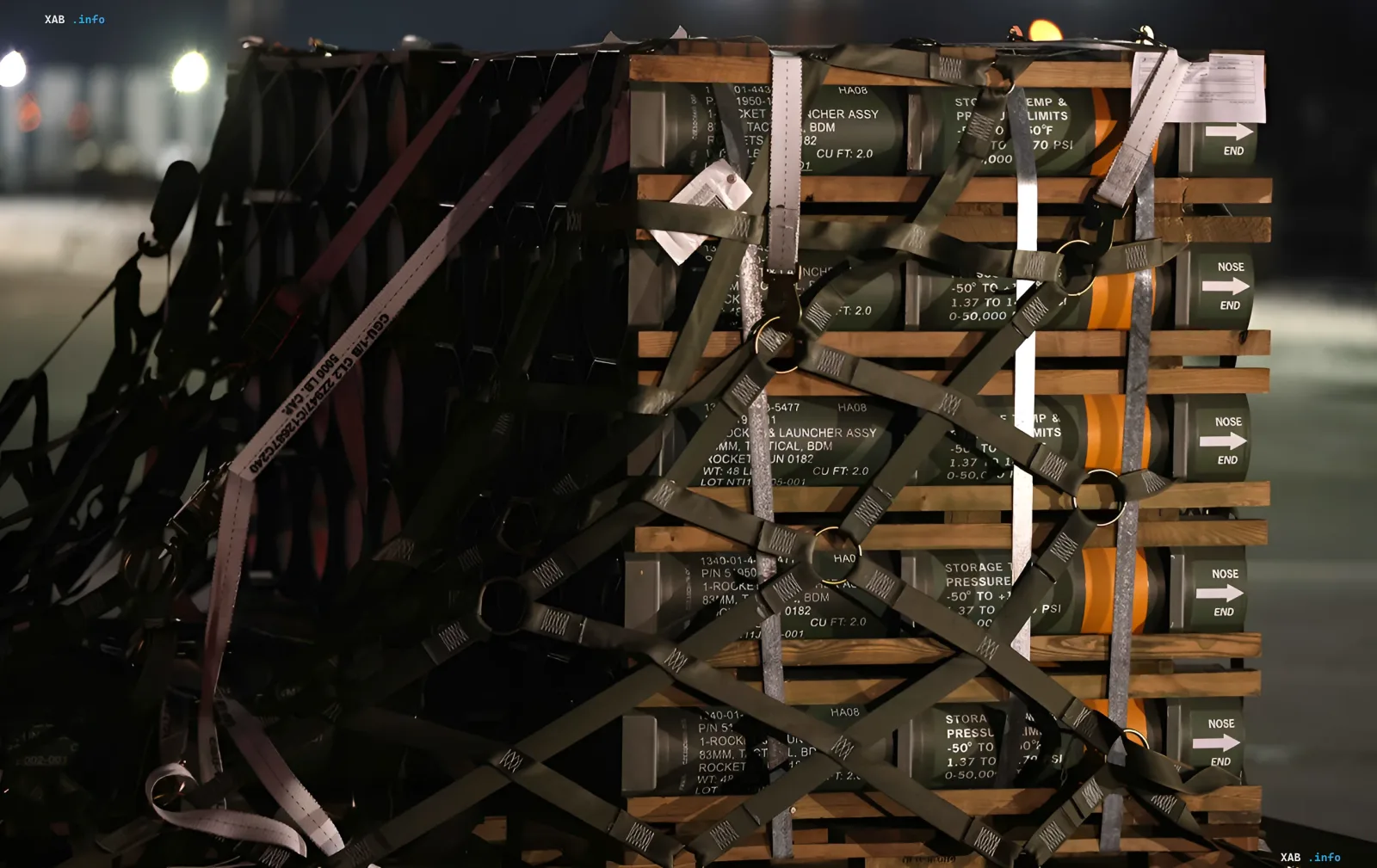
The manufacturers' associations link the refinement of the export procedure with the strategic significance of the Build with Ukraine format. In the context of the EU's Ukraine Support Loan of 90 billion euros for 2026–2027, of which 60 billion euros is earmarked for defense procurement, European partners are increasingly oriented toward production localization requirements. The industry associations' press release states that international partners have submitted more than 200 initiatives and cooperation applications, which to date remain unresolved or unanswered. The industry declared its readiness to join working groups and expert discussions on refining the procedure. Against this backdrop, the image accompanying the publication — rows of ammunition laid on wooden pallets and secured with tie-down straps marked "NOSE END," with storage temperature and pressure limits and tactical designations — vividly illustrates the very conventional arsenal whose export, in the weapons makers' assessment, under current conditions is burdened by a rate that makes contracts unprofitable.
Contradictory data
The public discourse around Resolution No. 875 and the related bill on budget amendments features a significant discrepancy in assessments. Industry associations insist that the 20–30% fee "makes exports economically unviable" and demand its zeroing out or substantial reduction, effectively calling for the abolition of the mechanism's financial component. At the same time, these same associations confirm that they support the very introduction of controlled exports as an "important signal for the industry and partner countries." Meanwhile, a group of Verkhovna Rada lawmakers viewed this fee not as a barrier but as a potential source of funding for the army, proposing to direct 50% of the funds to weapons procurement and 50% to servicemembers' allowances. The Rada rejected this bill in first reading on September 15, which means: neither the zeroing out of the fee as demanded by the industry, nor its targeted use for the army, has so far received legislative enshrinement. Thus, both sides — business and lawmakers — remain in a position where neither of the two alternative models has been implemented, and, according to industry data, more than 200 international cooperation applications remain unanswered.