Apricot jam is not just a winter preserve, but a true symbol of the passing summer. However, for many housewives, the process of making it turns into a trial: delicate fruits often turn into a shapeless mush, losing their aesthetics and texture. The XAB.info editorial team has analyzed a brilliant method that allows you to keep apricot halves absolutely whole, translucent, and incredibly appetizing, based on materials from the publication Styler.
The philosophy of "Quiet Jam": why you cannot stir
The main secret of this recipe, which has gone viral in culinary communities, lies in two fundamental rules that break the usual stereotypes of canning. First, this is long maceration in the refrigerator, and second — a categorical ban on stirring the jam while boiling. It is precisely the refusal of mechanical action with a spoon that allows you to preserve the structure of the fruit, making it look like glass.
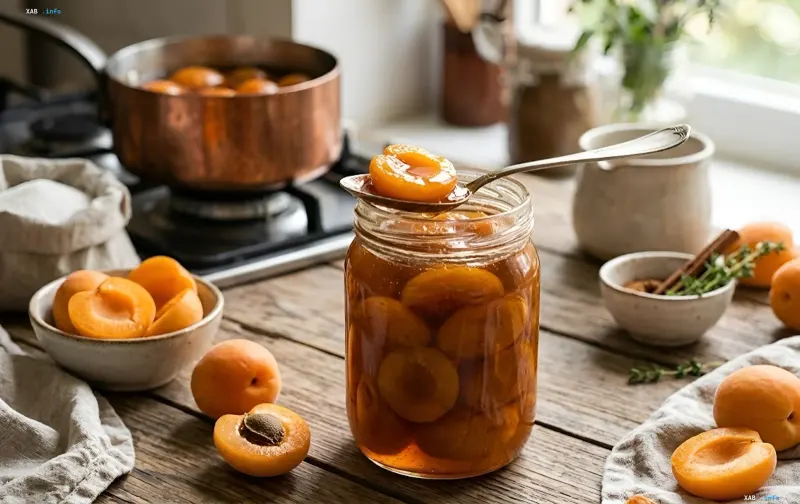
The process begins with careful preparation. Apricots need to be washed, divided into neat halves, and laid out in a wide dish with a thick bottom. Fruits are alternated with an abundant layer of sugar. It is important not to throw away the pits: you need to carefully extract the kernels from them and add them directly to the pot. This is not only an economy but also a way to give the finished dessert a refined almond aroma that opens up during cooking.
The magic of the refrigerator and amber syrup
The key stage that distinguishes this recipe from classic ones is waiting. The pot with the future jam must be put in the refrigerator for exactly 24 hours. During this time, a slow process takes place: sugar dissolves, drawing natural juice out of the fruits. As a result, a thick, rich syrup is formed, and the apricot halves themselves become beautiful, dense, and translucent.
After removing from the cold, the pot is placed on medium heat and the mass is brought to a boil. Here the rule of "do not touch" comes into force: the jam must not be stirred under any circumstances. When the syrup boils, you just need to carefully remove the formed foam, reduce the heat to a minimum and cook the dessert for exactly 40 minutes. The result is "royal" jam with a minimal set of ingredients, but maximum flavor.
Contradictory data
In the culinary environment, there are various approaches to making apricot jam, which may contradict the described method of "24-hour maceration". Traditional recipes, often found in Soviet collections and modern blogs (for example, on Unian or Glavred), suggest cooking jam in several stages with long breaks for cooling at room temperature. Supporters of the classic method claim that it is precisely multiple boiling that ensures better sterilization and a thicker texture of the syrup.
At the same time, supporters of the "cold start" (Styler method) insist that it is precisely cold maceration that preserves more vitamins and prevents the fruits from overcooking. The difference between versions boils down to priorities: speed and sterility versus preserving texture and "live" taste. In 2026, the trend is shifting towards preserving the natural structure of products, which makes the cold maceration method more relevant for gourmets.
2026 Context: trends towards naturalness
In the current year, when the food industry is increasingly focusing on clean eating and minimizing processing, recipes with a minimum number of ingredients are becoming particularly popular. The recipe from Styler, requiring only apricots, sugar, and kernels, fits perfectly into this trend. The absence of thickeners, pectin, and artificial additives makes such jam not just a sweet, but a valuable product.
In addition, the emphasis on the aesthetics of the product — whole, transparent halves — corresponds to the requests of the modern audience, which values the visual component of food. This is confirmed by the popularity of similar recipes in social networks and culinary applications. Thus, "quiet" jam becomes not just a preserve, but an element of a gastronomic lifestyle.