When a mushroom dish suddenly acquires an unpleasant bitter taste, the question arises whether it is safe to eat. Here, it is important to distinguish between the natural characteristics of a specific species, a harvesting mistake, and a situation where the safety of the product is in doubt.
Natural Characteristics and the Bitter Bolete
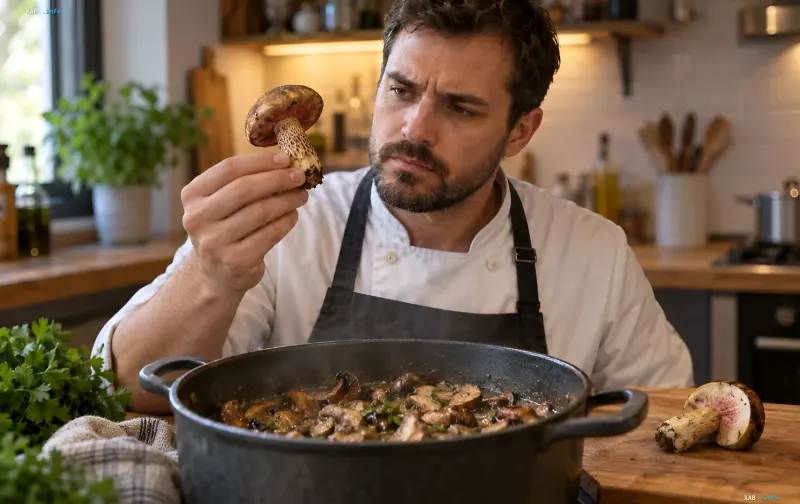
Mushrooms truly have different taste profiles. There are species considered inedible not because of strong poison, but due to an unpleasant taste or odor. The Ministry of Health of Ukraine specifically classifies the bitter bolete (Tylopilus felleus) in this group, as its unpleasant taste persists even after prolonged processing. Found in woodlands and mountainous regions, this mushroom outwardly resembles a porcini or bay bolete but features very bitter flesh and a distinctive net-like pattern on the stalk. Experts warn that the bitter bolete can completely ruin an entire dish.
How to Distinguish the Bitter Bolete from Edible Mushrooms
On young specimens, the difference might not be immediately noticeable. One characteristic reference point is the underside of the cap: the pores of the bitter bolete acquire a pinkish tint with age, whereas edible porcini pores are white or yellowish. Another sign is the dark network on the stalk, while edible mushrooms usually have a lighter mesh pattern. At the same time, relying solely on a taste test of a raw wild mushroom is strongly discouraged, as official guidelines advise against tasting unknown foraged species.
Contradictory Data
There are discrepancies in the public perception and official expert evaluation of the edibility and danger of wild mushrooms. On one hand, a common folk belief suggests that a bitter taste or unpleasant smell automatically indicates a deadly poisonous mushroom. On the other hand, mycologists and official agencies emphasize that bitterness is frequently just a gustatory feature of non-toxic yet inedible species like the bitter bolete. Nevertheless, experts agree that heat treatment and prolonged boiling cannot reliably destroy dangerous toxins if a genuinely toxic lookalike has entered the basket.
Safety Rules and Consumption Risks
If you know the exact species of mushrooms, but the finished dish unexpectedly turns bitter, the cause may be overripe or stale raw materials. Health authorities warn that old mushrooms can accumulate toxins, and cleaning or cooking does not guarantee their neutralization. If the taste changes sharply or an unusual odor appears, it is best not to try masking the bitterness with spices. The main rule: if you cannot accurately identify a mushroom or doubt the quality of the dish, do not risk it to save the meal.