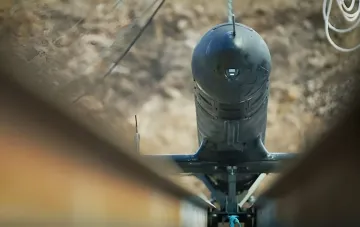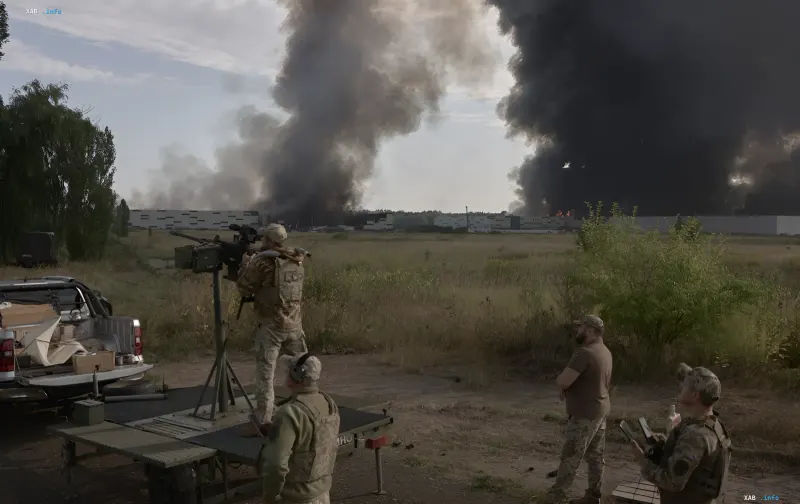
Since August 27, Russia has been carrying out a virtually unbroken series of strikes by jet-powered attack UAVs against Kyiv and the Kyiv region, combining them with traditional gasoline-powered 'Shaheds.' According to RBC-Ukraine, over eight consecutive days the enemy launched thousands of drones, with the share of jet-powered models — the 'Geran-4' and 'Geran-5' — exceeding two-thirds in some waves. The targets included warehouses and distribution centers of retail chains, logistics companies, and enterprises involved in the defense-industrial complex. Kremlin spokesperson Dmitry Peskov had previously stated publicly that Kyiv would feel the 'retribution every day and every night' for the strikes on Ozon infrastructure, however, according to the outlet's sources, Moscow had been preparing for the escalation and ramping up production of jet-powered drones well before those threats.
From 'Geran-3' to 'Geran-5': the timeline of the shift to turbine power
The first in Russia's current line of jet-powered UAVs was the 'Geran-3,' whose combat use against Ukraine was recorded as early as 2025. In early 2026, the 'Geran-5' was deployed for the first time during combined attacks, and in May another model — the 'Geran-4' — was revealed. Yuri Ignat, head of the communications department of the Air Command, reported that in July Russia used five times more jet-powered UAVs than in June, and in August more than 2,800 such devices were used against Ukraine. From August 27, the strike pattern changed radically: jet-powered drones ceased to be an occasional addition and became a systematic component of every wave. On the night of August 27, of the 258 attack UAVs launched, about a third were identified by the Air Force as jet-powered; during the day of the same date, of roughly 140 devices, more than 100 were jet-powered, and most of them were directed specifically toward the capital. On September 1 during the day, 72 of the 99 UAVs launched were jet-powered, and from September 2 to 4 their share, according to Air Force estimates, was about half of all 'Shaheds' used.
Production plans: what Moscow is preparing for November
RBC-Ukraine's sources in various military circles emphasize that the current attack pattern is not a short-term experiment. The formation directly carrying out strikes on Ukraine is allocated about 160 attack drones per day — both jet-powered and gasoline-powered. According to the outlet's sources, in September Moscow plans to manufacture 2,700 'Geran-2' units, 1,200 'Geran-4,' 800 'Geran-5,' and 5,000 'Gerber.' By November, according to the same information, the enemy intends to raise the share of jet-powered drones in attacks to about 80% through increased production, leaving around 20% for traditional gasoline-powered 'Shaheds.' Thus, current production capacity allows Russia to sustain virtually daily drone strikes in the mode that Ukraine has been observing for a week.
Technical specifications and bottlenecks
The main difference between jet-powered UAVs and gasoline-powered ones is speed and flight altitude. The 'Geran-4' has a cruising speed of about 320 km/h and can climb to 4 km. The significantly larger 'Geran-5' flies at a speed of roughly 450–600 km/h and reaches greater altitudes, making it harder to intercept for air defense systems designed for slow, low-flying targets. According to the GUR portal War&Sanctions, Russia uses turbojet engines from the Chinese manufacturer Telefly in its jet-powered 'Gerans.' However, according to RBC-Ukraine, only about 3,000 such engines have arrived from the PRC — one-sixth of Moscow's needs. This is precisely why the Kremlin is seeking ways to establish their production independently. As early as August, the GUR reported that Russia had stopped producing the 'Geran-3'; the outlet's sources link this to the reallocation of components to the 'Geran-4' and 'Geran-5,' which Moscow considers more effective.
Contradictory data
Different sources interpret the nature of the current campaign differently. RBC-Ukraine, relying on production plans and statements from military sources, characterizes the shift to jet-powered drones as a long-term strategic restructuring designed to last months. The Washington Post, in turn, describes the mass launches of jet-powered UAVs primarily as a tactical measure to overload and exhaust Ukraine's air defense systems, i.e., as a tool intended to 'burn through' air defense missiles and open up space for subsequent strikes. The two versions do not exclude each other, however, they differ in their assessment of the planning horizon: tactical overload implies a temporary nature, whereas the production figures for September and November point to a sustained program. In addition, the bulk of publications focus on Kyiv and the Kyiv region as the main direction, while individual reports (including the striking of the largest warehouse complex in the Odesa region) indicate that the geography of jet-powered strikes is broader than the Kyiv narrative suggests. Exact figures on daily production and the actual share of jet-powered drones in each specific wave vary according to different sources: in one attack it is about a third, in another — half, and in some daytime waves — more than two-thirds of the devices launched.
What to expect in autumn
The totality of available data indicates that during the autumn period Ukraine should expect not only the maintenance but the further increase of the share of jet-powered UAVs in combined strikes. With the planned shift to an 80% share of turbine-powered drones by November, the load on air defense and early warning systems will rise manifold: a speed of 450–600 km/h and a flight altitude of several kilometers shorten the reaction time of air defense units. At the same time, Moscow, according to available information, is simultaneously preparing new massive combined attacks, in which jet-powered and gasoline-powered drones will be used in even denser waves. For the civilian population, this means that the intervals between strike waves will shorten, and the number of targets coming under fire within a single series will expand beyond the initial list of logistics and retail facilities.