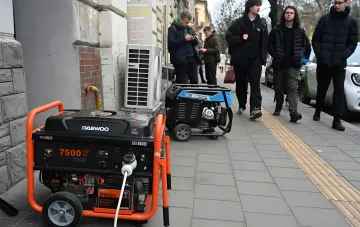
With the first steady cold spells in Ukraine, the issue of cities' readiness for winter comes to the forefront. For Kyiv, this is particularly acute: the capital's energy system is under constant attack, and the city depends on external power supplies for more than 95%. In an interview with the YouTube channel “ETO BAZA”, Oleksandr Vizir, coordinator of the Energy and Climate sector at the Ukraine Facility Platform analytical center, spoke about what residents of Kyiv should expect from blackouts, how the metro and water utility operate without external power, and how prepared the capital is for freezing temperatures.
Forecast: From 8 to 20 Hours Without Power in Freezing Weather
According to Vizir's estimate, the duration of outages in winter will heavily depend on the district: where specific infrastructure is damaged, power may be cut off for a long time, while areas connected to critical infrastructure will see a better situation. Taking the “average temperature in the hospital” at a steady −10 °C, the expert cites a range of 8 to 20 hours of power outages per day. At the same time, he considers 8 hours a super-optimistic scenario possible only at temperatures near zero; 12–16 hours as arguably the most likely scenario at −10 °C; and 16 hours or more as a bad scenario, although, according to him, outages could be even longer.
Threat of Complete Disconnection from the Power Grid
Russia, according to the expert, is deliberately targeting substations that transmit power to Kyiv from the outside: west of the capital to hinder energy transmission from the Rivne and Khmelnytskyi NPPs, as well as a substation near Brovary that ensures energy transmission across the Dnipro to Chernihiv, Poltava, and Kharkiv. At the same time, Kyiv's power grid is looped and has connections from the south, making it extremely difficult to completely cut off the capital from generation. However, Vizir emphasizes that the volume of energy for the city's critical infrastructure (over 500 MW) must be secured, and he does not guarantee that “everything will be fine.” A separate issue is the crossings across the Dnipro: out of 11 lines, two are damaged, and restoration requires a specific crane and watercraft, making the procedure lengthy; during mass attacks, a «triage» situation arises where resources for repair are not enough for all lines.
Metro and Water Utility Without External Power
The metro system, according to the expert, will be able to maintain the minimum necessary level of operation in the absence of external power. As a successful example, he cites the Kharkiv metro, where gas-piston units have already been installed, and batteries are planned to be added by the end of the year, looping the system and placing some equipment directly underground. In Kyiv, Vizir notes, traffic on some metro branches was already stopped on October 8, 10, and 14. The situation with water is more complicated: the water utility has no reserves to operate fully without grid electricity, although sewage operations will be maintained.
Heat and General Readiness: 2 Out of 5 Stars
In winter, according to the expert's assessment, there is a possibility of repeating the situation with long-term absence of heat in certain districts of the capital. Regarding general readiness, Vizir states: Kyiv could become a model for other cities, but today the general level of preparation is rated at 2 out of 5. Thus, if the intensity of infrastructure attacks continues, residents of the capital should prepare for prolonged blackouts, water supply disruptions, and local heating problems during the coldest periods.