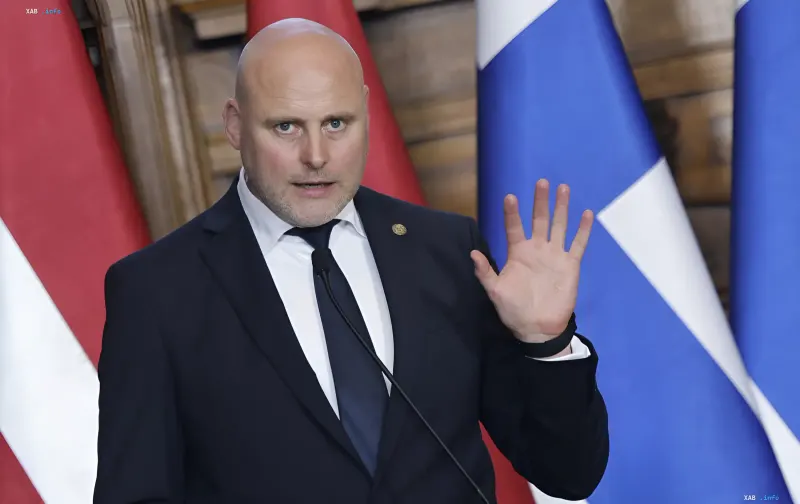
The Prime Minister of Latvia, Andris Kulbergs, made a sharp statement at a press conference following the meeting of the Coalition of the Willing, saying that European countries should not bear the cost of the consequences of Russian aggression on their own. In his words, the “bill” should be covered using frozen Russian assets, which, according to Kulbergs’s estimate, amount to around €200 billion. “Not the money of EU citizens, but Russia’s frozen assets, in order to pay this bill,” the Prime Minister emphasized, referring to a position that, he said, “was very correctly noted by the representatives of Sweden” during the discussions.
“The bill is very high”: Riga’s argument
Kulbergs stressed that the matter concerns substantial funds needed to cover the damage from Russian attacks, and posed a rhetorical question: “Why should EU citizens pay this bill in full?” In his view, using frozen Russian assets would significantly reduce the financial burden on European countries. The Prime Minister also quoted Ukrainian President Volodymyr Zelenskyy, who, according to him, “had just noted” that the price of the war is “extremely high,” and called to “take this burden off their shoulders.”
Belgium’s position and legal risks
Earlier, Belgium, on whose territory a significant portion of the frozen Russian assets is held through the Euroclear system, stated that it allows for their use in favor of Ukraine. However, Brussels insists on prior coordination among EU countries on a mechanism for distributing legal and financial risks. Belgian authorities fear that, in the event of an obligation to return more than €200 billion to Russia, the country would not be able to cover such expenses on its own. At the same time, Belgium does not object to using these funds to support Ukraine, provided that an adequate system of protection against regressive claims is established.
Contradictory data
The statements of the parties show differences in wording and emphasis. Kulbergs speaks of assets that are “available to cover the bill,” implying readiness for their direct use. Belgium, for its part, frames its position as allowing use subject to agreement on a risk-distribution mechanism, effectively indicating that the assets are not yet “free” to be spent without legal protection. In addition, in the context of earlier statements (May 2026), Kyiv had put forward an initiative to “seize” the frozen assets for compensation, which has sparked a debate over whether this refers to irreversible confiscation, to a loan with subsequent repayment, or to a compensation mechanism with guarantees. These differences in terminology and legal qualification remain the subject of active negotiations within the Coalition of the Willing.
Context: the Coalition of the Willing and Sweden’s role
The meeting of the Coalition of the Willing, following which Kulbergs made his statements, became yet another forum for coordinating the position of European countries on issues of supporting Ukraine and financing its reconstruction. Kulbergs’s mention of the representatives of Sweden indicates that Stockholm, during the discussions, put forward an argument in favor of using precisely the frozen assets rather than EU budgetary funds. This reflects growing intra-European pressure on the asset-holding countries and on the European Commission to develop a unified mechanism for deploying them by the end of 2026.