
In the public mind, apple pie is often associated with a heavy, very sweet dessert that quickly gets tiresome. However, there is an approach in which the baked treat turns out delicate and fruity rather than "floury." This is exactly the version offered by the Styler project from RBC-Ukraine, referencing a video from the "Delicious and Simple" page on Facebook. According to the publication, the finished product contains about 100 kcal per 100 grams, making the dessert relatively light. The original Styler article emphasizes that no complicated techniques are required: you just need to slice the fruit thinly, mix the ingredients, and put the dish in the oven.
The Key Secret — Slice Thickness
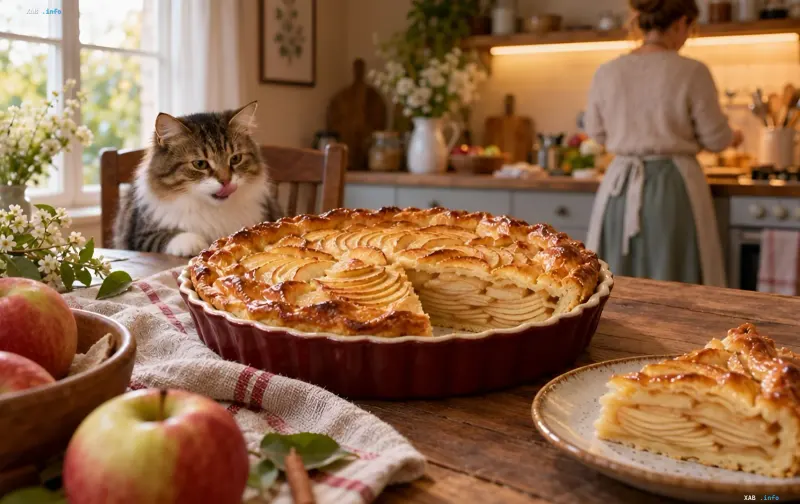
The main technical detail of the recipe, which the source highlights, is how the apples are cut. The fruit should be sliced very thinly, roughly 1–2 mm thick. This slicing allows the apples to bake through well and become part of a delicate fruity filling, rather than remaining raw inside. It is precisely thanks to these thin "layers" that the dessert earned the name "layer cake" in the publication's headline: neat horizontal lines of sliced apples are visible, as in the accompanying photo with the golden crust and a slice served on a plate.
Minimal Ingredients and Simple Assembly
In a separate bowl, the eggs, milk, sugar, melted butter, flour, baking powder, as well as lemon zest and juice are mixed together. The lemon serves a dual function: it adds a light tartness that balances the sweetness and helps preserve the color and structure of the apples. The apples are then added to the batter and stirred in. If desired, some of the apples can be replaced with pear or pumpkin — this extends the seasonal range of the recipe and lets you use whatever is on hand. The dish is lined with parchment paper, and the apples are either layered in or mixed straight into the batter and transferred to the dish.
The Main Nuance — Don't Rush the Dish
The most common mistake with this method of preparation is trying to remove the dessert from the dish immediately after it comes out of the oven. The source warns directly: the cake must cool completely, otherwise the hot baked treat may lose its shape. For the best stabilization, it is recommended to place it in the refrigerator for several hours. This step is critical precisely because the recipe does not use a classic dense shortcrust pastry, but relies on a setting egg-and-milk base that needs time to "set."
Context and Alternatives
The proposed version fits into a broader trend toward simple homemade desserts without extra steps. Recipe roundups on related platforms feature other interpretations of apple pie as well — for example, versions with yogurt and no sugar, which, according to their authors, keep for a long time, or express recipes taking 40–50 minutes. Nevertheless, it is the Styler version that stands out for its emphasis on the "layer" texture and on thermal stabilization after baking, rather than on speed. For those who want to recreate the dessert, the guideline is simple: thin slicing, lemon, parchment, and patience while cooling — and what ends up on the table is a delicate fruity cake, not a heavy sweet mass.