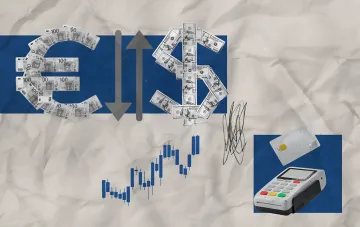
The Ukrainian currency market during the period from September 14 to 20, 2026 is expected, according to experts, to remain relatively stable. Taras Lesovoy, Director of the Financial Markets and Investment Activities Department of Globus Bank, told RBC-Ukraine that the dollar on the cash market could reach up to 45 hryvnia, while the euro, due to its dependence on global quotes, will have a wider range of fluctuations. The market's outward calm, he said, is the result of the National Bank's managed flexibility policy, which prevents accumulated currency demand from turning into an uncontrolled movement of the exchange rate.
Dollar: a narrow corridor on the interbank and cash markets
According to Taras Lesovoy's forecast, next week the dollar rate on the interbank market will fluctuate within the range of 44.4–44.8 UAH per dollar. On the cash market, the allowable corridor will be 44.5–45 UAH. Daily rate changes on the interbank may reach 0.05–0.15 UAH, at commercial banks — 0.1–0.2 UAH, and at exchange offices — up to 0.3 UAH. The difference between buying and selling rates (the spread) on the interbank will be up to 0.15 UAH per dollar, at commercial banks — up to 0.5–0.6 UAH, and at exchange offices — up to 0.6–1 UAH. The average difference between interbank and cash market rates is forecast at 0.1–0.15 UAH.
Euro: a wider room for movement
Unlike the dollar, the euro will have a noticeably wider room for movement. Both on the interbank and on the cash market, the euro rate is forecast within the range of 51–52.5 UAH. The interbank spread for the euro will be up to 0.2 UAH, at commercial banks — up to 0.8–1 UAH, and at exchange offices — up to 1–1.3 UAH. The average difference between buying rates on the cash market will be 0.3–0.5 UAH per euro at banks and 0.5–0.7 UAH at exchange offices. The wider range is explained by the euro rate's dependence on dynamics at global currency venues, where volatility is traditionally higher than for the dollar.
NBU interventions and the structural currency deficit
Next week, the need for National Bank interventions will remain significant. According to a preliminary estimate, the regulator may direct about 0.8–1 billion dollars to maintain the balance between supply and demand. Active demand from importers will persist on the interbank, primarily from companies purchasing fuel and energy equipment. As the autumn–winter period approaches, the need for critical imported goods is unlikely to decrease. Meanwhile, the possibilities of Ukrainian exports in wartime conditions remain limited, and natural currency inflows are insufficient to fully cover demand. Part of this gap is forced to be covered by the National Bank from its own reserves.
"War inflation": prices may rise even with a stable rate
The expert drew attention to an important nuance: despite the relative stability of the exchange rate, the cost of goods and services in Ukraine may rise under the influence of other factors. This refers to the consequences of missile and drone attacks, losses at enterprises, the restructuring of logistics, spending on energy independence, risk insurance, reserve routes and equipment. All of this forms so-called "war inflation," when businesses build into prices not only the damage already incurred but also possible future expenses. According to Lesovoy's forecast, in September price growth on certain commodity markets and in the services sector may reach about 5%, and in the event of a supply shortage due to force majeure circumstances — up to 10%.
Risks and limitations of the forecast
Taras Lesovoy emphasized that in wartime conditions any currency forecast involves many conditions. The situation may change due to new attacks, losses of energy or logistics capacity, and other unforeseen circumstances. However, under current conditions, the currency market during the period from September 14 to 20 is unlikely, in the expert's assessment, to go beyond the already established trends. Average weekly deviations are expected within 1–1.5% of the week's starting rate. The analyst stresses that the data provided is for informational purposes only and does not constitute financial or investment advice. Investments carry risk, including the possibility of total loss of capital, and it is recommended to consult a licensed advisor before making any financial decisions.