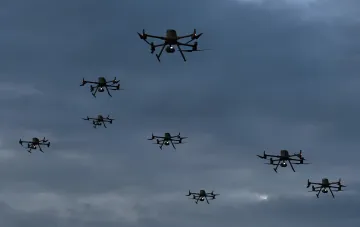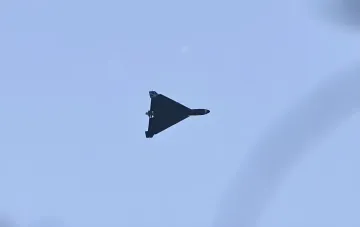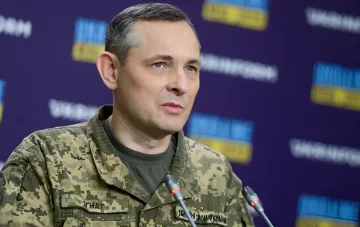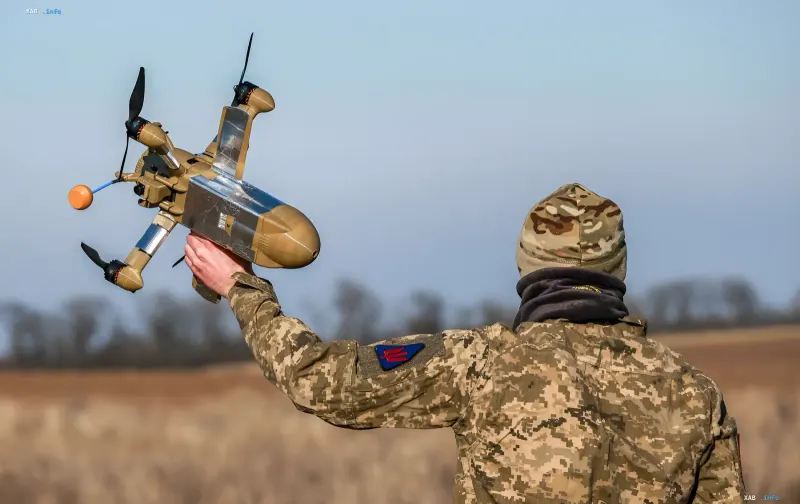
The Ukrainian military is already using seven different models of interceptor drones designed to intercept jet-powered strike UAVs of the Shahed / Geran type. This was stated by Andrii Hrytsenyuk, head of the Brave1 defense cluster, in a comment transmitted by RBC-Ukraine with reference to the Oboronka Telegram channel. According to him, the transition from combating conventional propeller-driven drones to countering jet-driven ones was a consequence of realizing that previous air defense tactics could not cope with high-speed targets, and it was at this moment that funds were allocated to develop new solutions.
From Propeller Shaheds to Jets: A Paradigm Shift
Hrytsenyuk explained that the turning point came in the summer of 2025, when interceptor drones effectively closed the airspace to conventional propeller-driven Shaheds. "That is when funding began for teams working on solutions against jet drones. We are not just talking about high-speed interceptors," he emphasized. Thus, Ukraine's air defense system has passed the stage of adaptation to one class of threats and moved on to countering a more complex one—jet-powered UAVs that fly at significantly higher speeds and require different interceptor characteristics.
Twenty-Two Teams and Three Technological Directions
Currently, 22 developer teams are involved in creating high-speed drones against jet-powered Gerans, 12 of which have received state funding through the Brave1 cluster. Hrytsenyuk named three main technological directions: projects with miniature turbojet engines, electric models with propellers, and drones with a ducted-fan (impeller) engine—structurally resembling a turbine engine but powered by an electric battery. The diversity of approaches indicates that there is as yet no single "correct" solution, and the state has set the task of developing several technological branches in parallel to reduce the risk of dependence on a single type of power plant.
A Thousand Interceptors and the Scaling Problem
The Ukrainian government has already contracted new interceptors in quantities that, according to Hrytsenyuk, "have long exceeded a thousand." However, production is at the scaling stage, and the head of Brave1 explicitly warned that catching-up output growth will not happen instantly. As an analogy, he cited the experience of the previous cycle: when conventional Shaheds were used en masse, scaling up interceptor production took about six months. "We will certainly catch up with the output of Russian drones. But this will not happen in days or weeks," he stated, emphasizing that all efforts are aimed at accelerating processes, but the physics of production takes time.
Waves of Jet Drones and Attrition Tactics
The context for accelerating the development of interceptors is created by the tactics of the Russian Air Force. As the Center for Countering Disinformation previously reported, Russia launches jet drones in waves, with the main goal of such tactics being to exhaust air defense assets and paralyze the life of the capital with constant air raid alerts. It was separately noted that the Russian industry is operating at an accelerated pace: jet drones are launched against Ukraine almost immediately after coming off the assembly line, without long-term storage in warehouses. This means that the Ukrainian side cannot rely on a time lag between production and deployment by the enemy and is forced to scale up its own pace in parallel.
Broader Context: From Trials to Serial Production
Hrytsenyuk's statements fit into a broader picture provided by other sources. President Volodymyr Zelenskyy, in an interview with the Financial Times, reported that Ukraine is testing five models of high-speed interceptors, one of which is planned to be brought into production in a volume of about 400 units by the end of October, while four remain in the testing stage. Zelenskyy also pointed out that over the past day, Russia has launched about 500 UAVs, approximately half of which were jet-powered, and that Ukraine destroys about 57% of jet drones compared to 85–90% for conventional ones. He named a shortage of engines, a significant portion of which are imported, as the key problem in scaling. Head of the Presidential Office Kyrylo Budanov, in turn, stated that interceptor prototypes are already being tested in combat conditions and are shooting down enemy drones, and mass deployment could begin within a few months. At the same time, Reuters reported in early July on a failure during tests of a new batch of Ukrainian interceptor drones, indicating that the path from prototype to serial product remains non-linear and includes both successful and failed cycles.