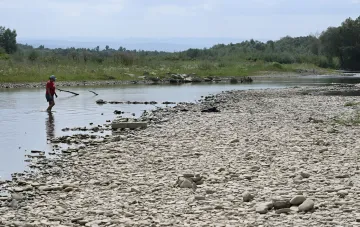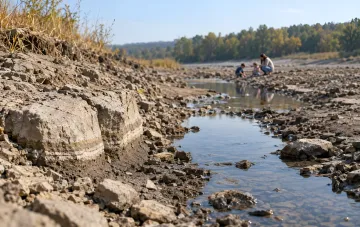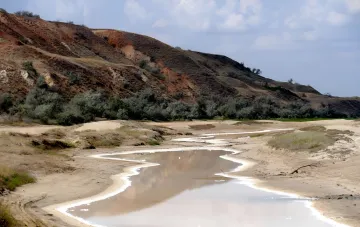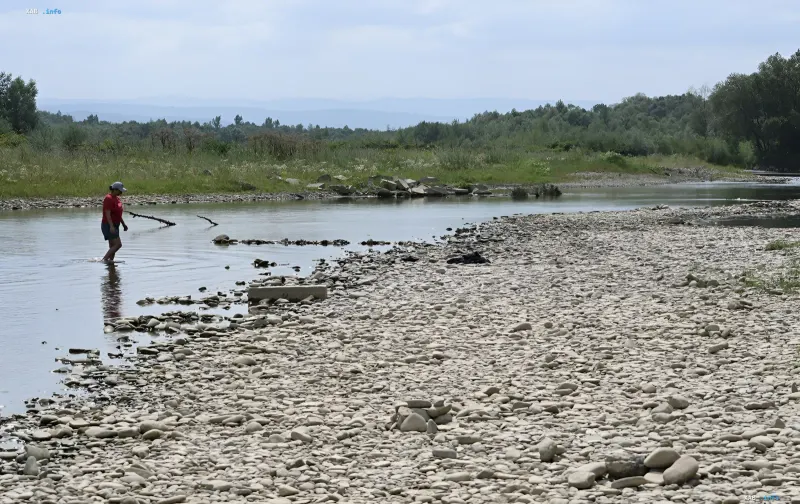
The Ukrainian Hydrometeorological Center (UkrGMs) has published an operational assessment of the water levels of the country's main rivers for August 2026, which confirms an alarming trend: low-water conditions — a hydrological drought — not only persisted during the last month of summer but intensified in a number of river basins. The data were calculated at the cross-sections of operating hydrological stations in accordance with the Regulation on the Procedure for Assessing and Reporting Low-Water Conditions on Ukraine's Surface Water Bodies, which defines the primary and auxiliary criteria for recording the onset or threat of a hydrological drought.
Hydrological drought: methodology and criteria
The assessment of the water levels of Ukraine's main rivers is carried out to determine the likelihood of low-water conditions — a state in which the volume of river runoff falls below the critical values needed to sustain ecosystems, supply the population with water, and keep water-dependent sectors of the economy functioning. UkrGMs uses two levels of criteria: a primary one, by which the low-water condition itself is recorded, and an auxiliary one, based on comparing the monthly water level with the average long-term value for the driest month of the year. It is precisely this methodology that allows specialists not merely to note a drop in water level but to classify the degree of threat for specific basins.
August 2026: a spread from 379% to a complete loss of runoff
The published data show an extremely uneven picture across the country. At some cross-sections the average water level for August exceeded the norm by 1.5 to 3.8 times (149% and 379%), while in other basins the figures fell to 21–29% of the norm — that is, approached the formal criteria for low-water conditions. A significant share of rivers fell within the 31–49% of the norm range, which specialists describe as "well below the norm." By the primary assessment criterion, low-water conditions were observed during August and continued to intensify in a number of basins, while on the remaining rivers — whose hydrological regime affects the operation of water-dependent economic sectors and the water supply of the population — the monthly water level was below the average long-term value for the driest month of the year.
Ecological flow: rivers below the critical threshold
Particular concern among experts is raised by the situation with ecological flow — the minimum volume of water needed to sustain the vital functions of a river's ecosystem. According to UkrGMs, a complex hydrological situation, associated with water levels being held below ecological-flow values, was observed in a number of basins. Specialists state outright that such a state is "critical for the functioning of river ecosystems," because a prolonged water deficit disrupts self-purification processes, destroys spawning grounds, and degrades riparian zones. The only factor that allowed certain rivers to keep their water levels above that of the driest month was the operation of the Dnipro–Ingulets canal and the Karachunivske reservoir, which provide backwater and regulate runoff in the lower reaches of the Dnipro.
The Stokhody River: the flow has effectively stopped
The most dramatic case was recorded on a tributary of the Pripyat — the Stokhody River near the Liubeshiv station. From 5 August 2026, there has been no runoff at all on this stretch: the flow has effectively stopped, and the water has become stagnant. This means the river has ceased to perform its natural function of transporting water, oxygen, and nutrients, which for the local ecosystem is equivalent to the death of the water body. According to UkrGMs, a similar picture is typical for a number of small and medium-sized rivers in the context of a weak spring flood followed by a precipitation deficit.
Context: from July's minimums to danger level III
The August assessment is not an isolated event. As early as July 2026, water-level indicators on a number of Ukrainian rivers were at a critical level against the backdrop of a weak spring flood and the subsequent weather conditions. At the end of August, in certain regions, danger level III — the highest on the hydrometeorological alert scale — was declared due to the further decline in water levels, which calls for emergency measures to regulate water use. Meanwhile, a number of the country's reservoirs are setting anti-records for the volume of water stored, creating a double burden: on the water supply for the population, on the energy sector, and on the ecological state of river ecosystems.